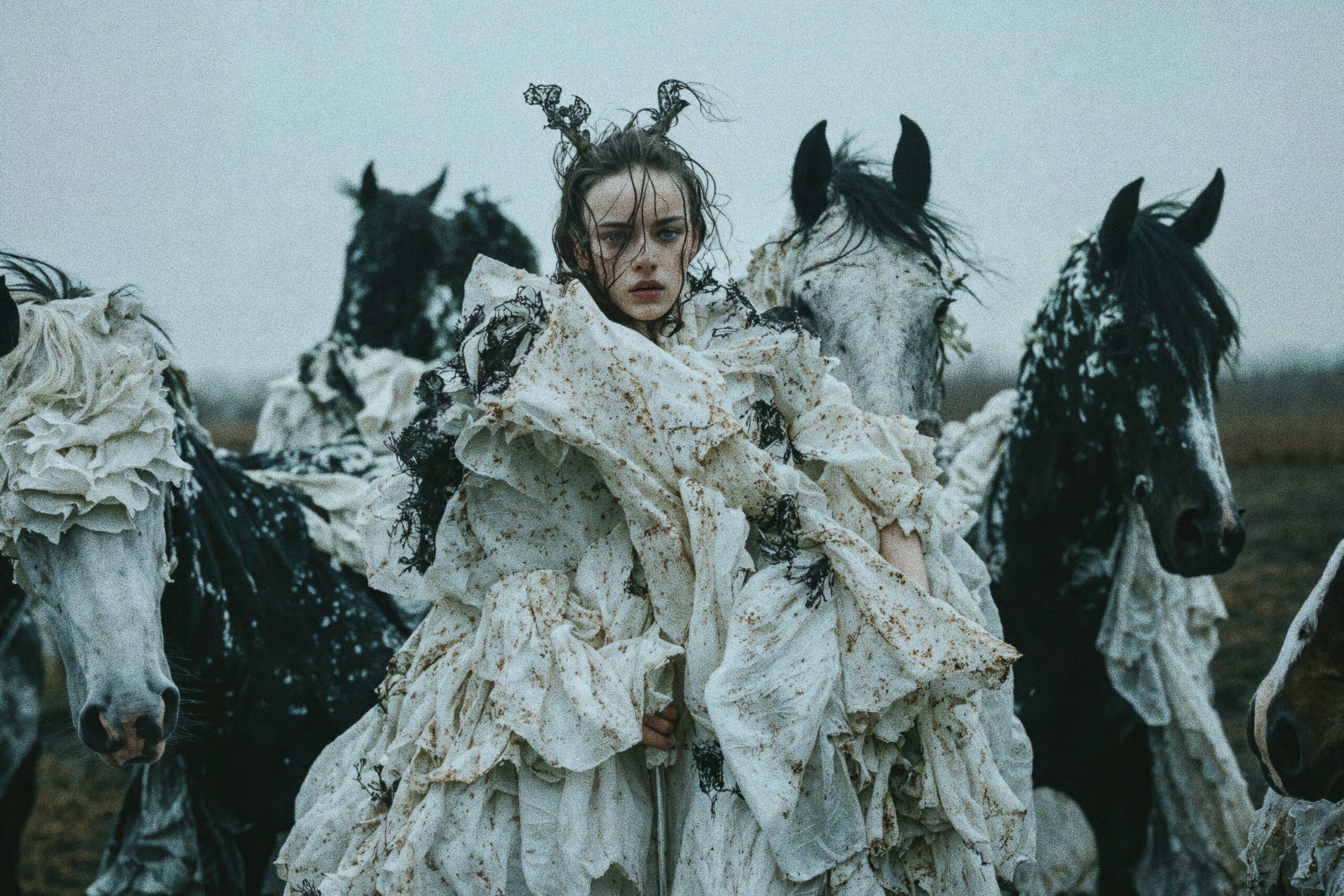
Where photography, artificial intelligence, language, scent, sound, and sculpture converge to form a sensorial mythology.
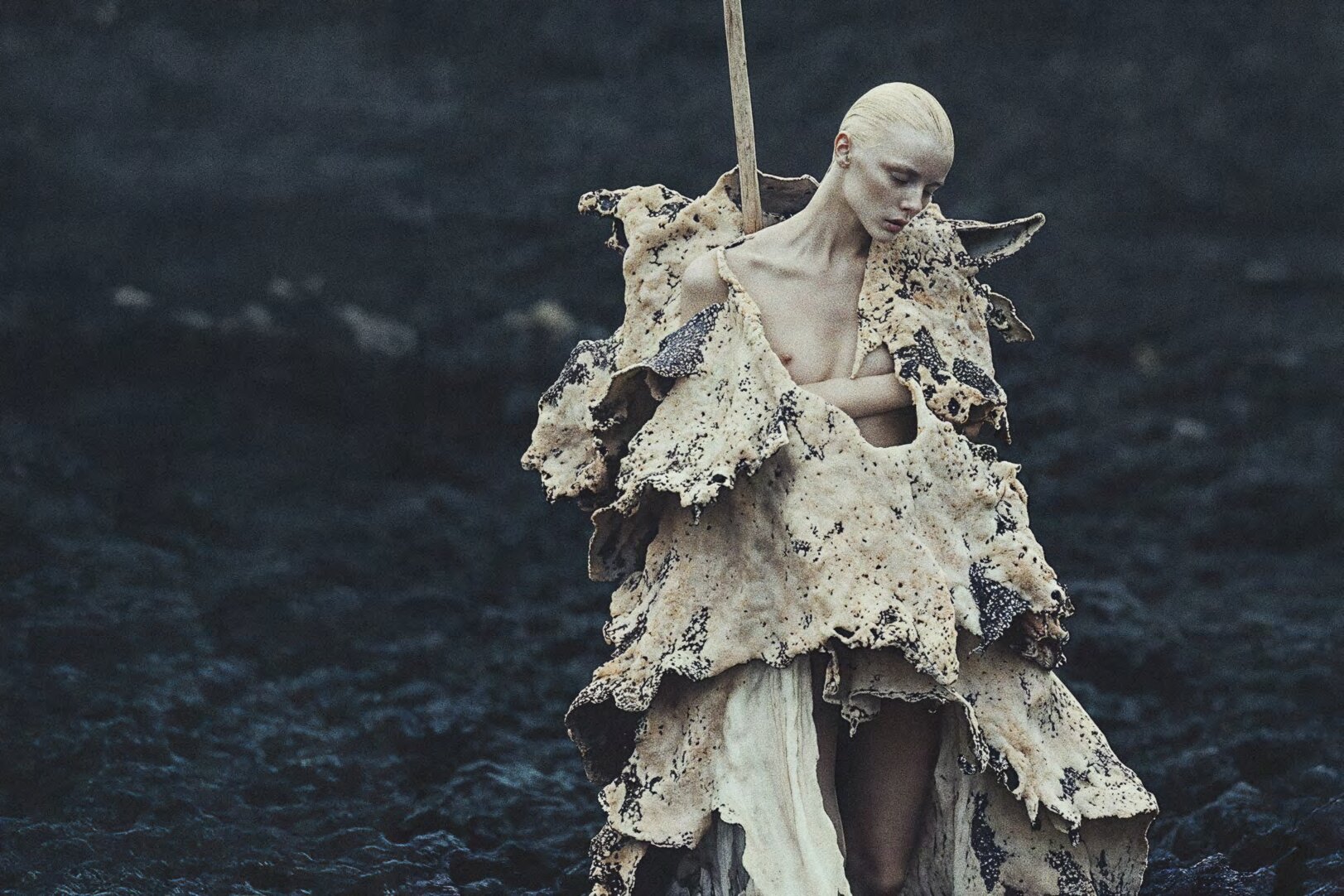
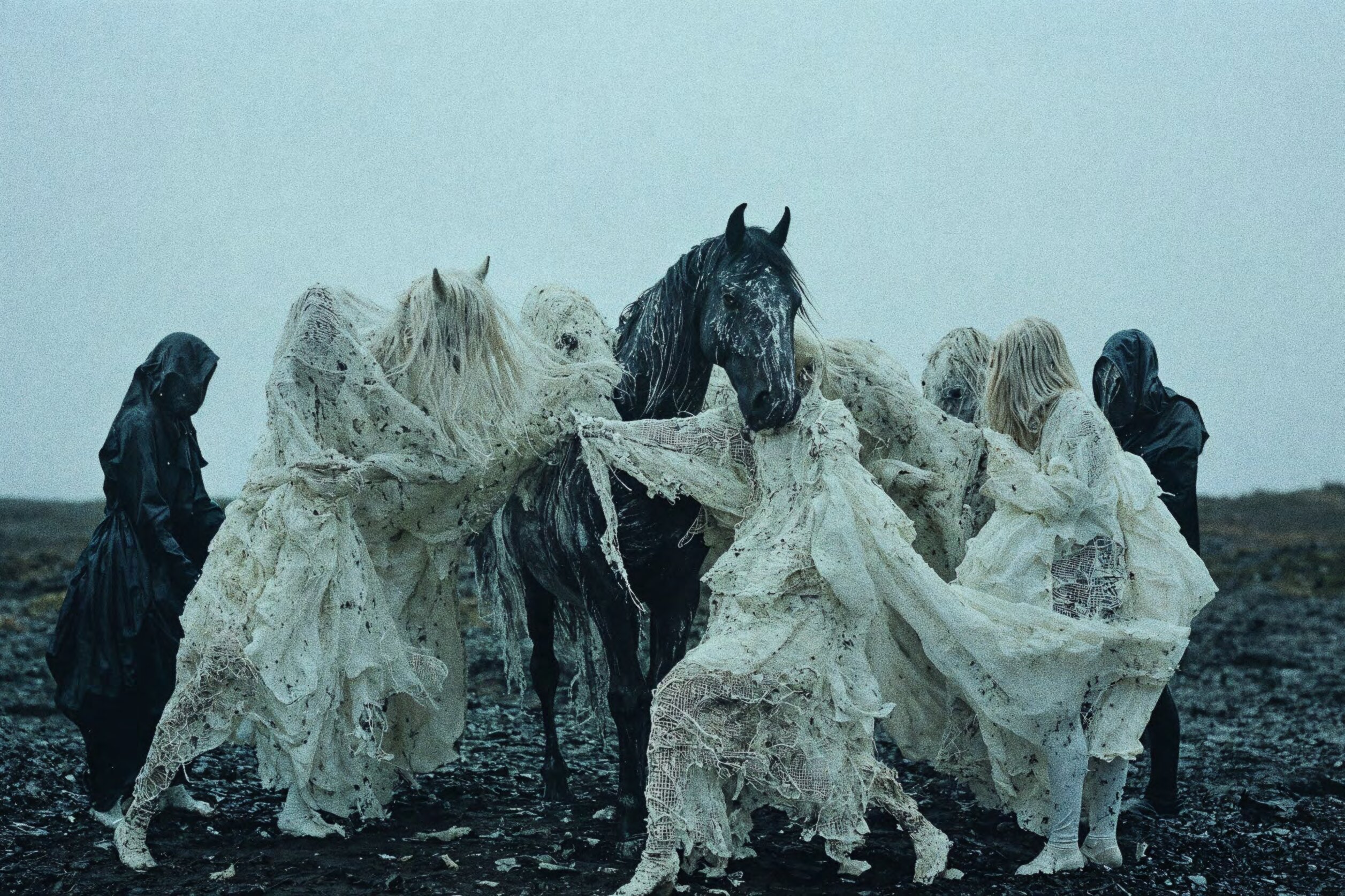
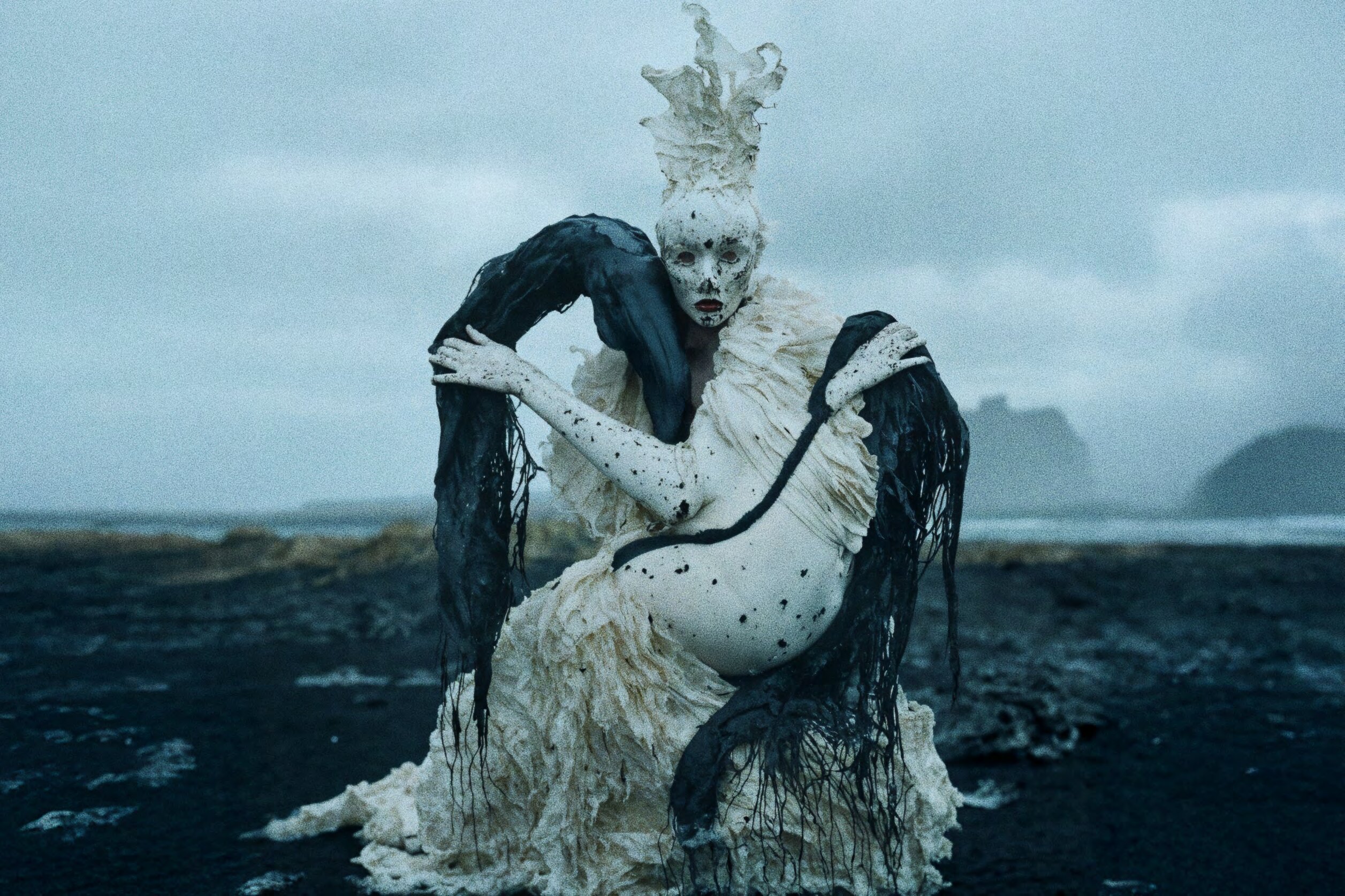
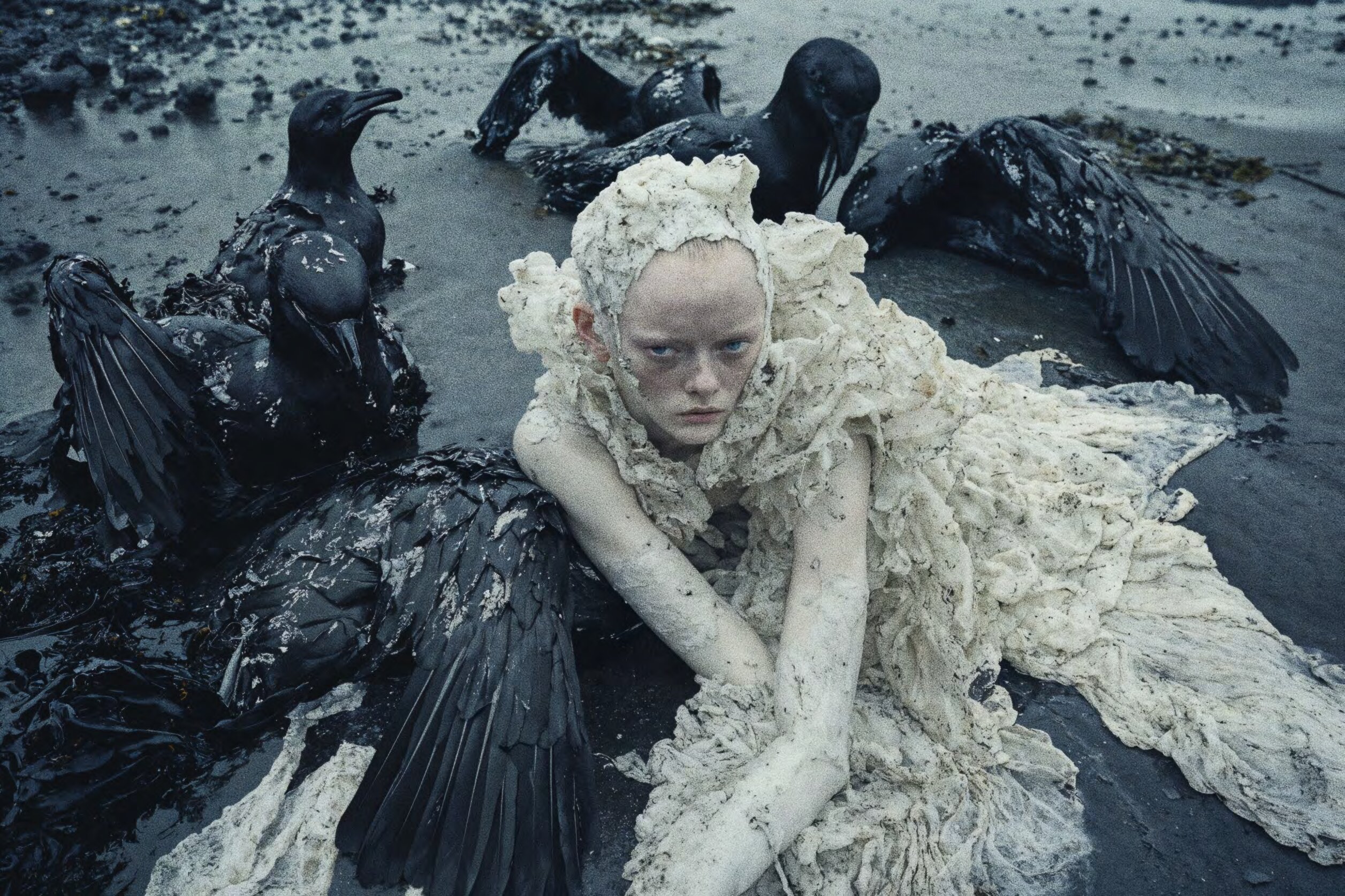
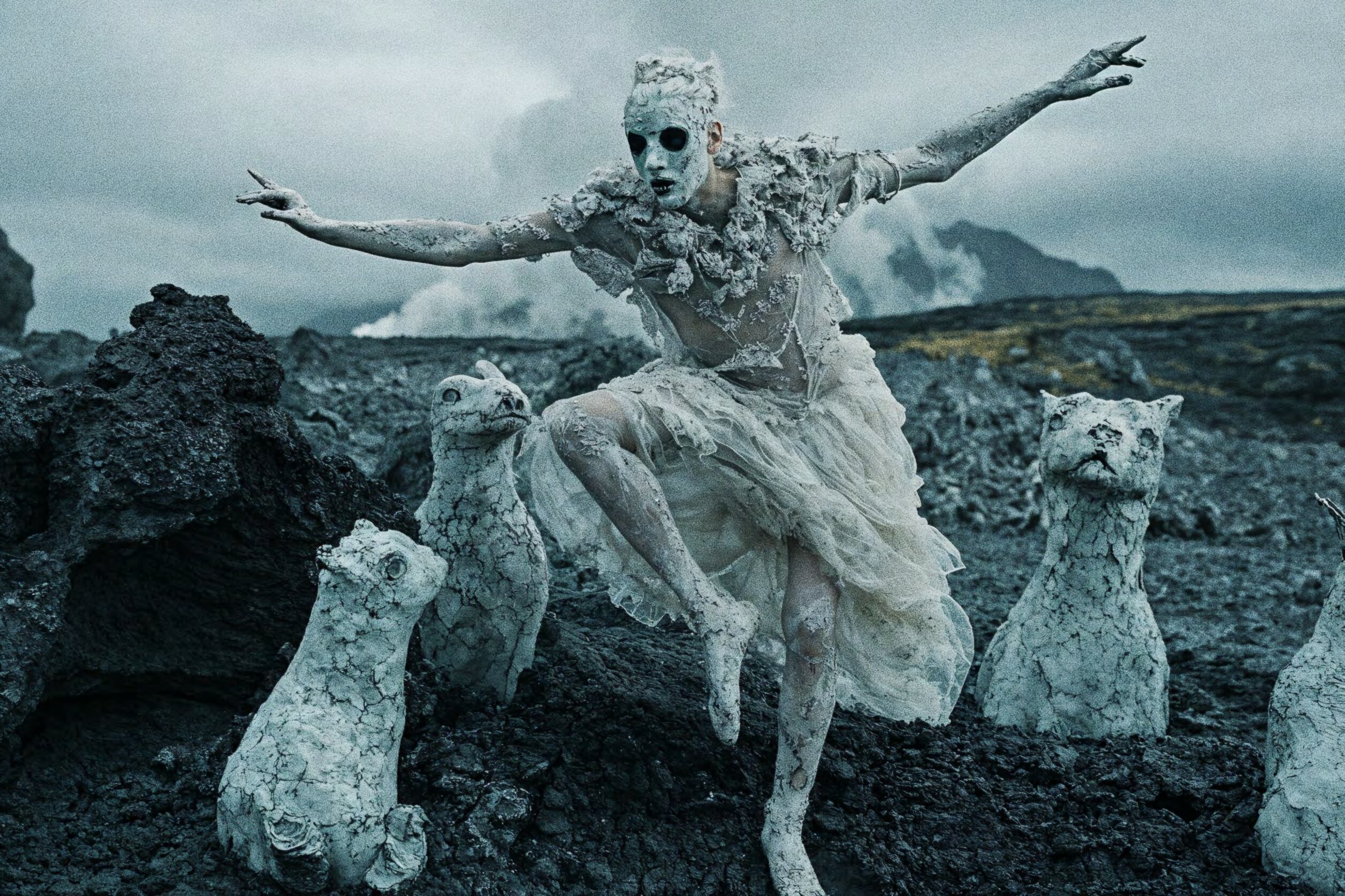
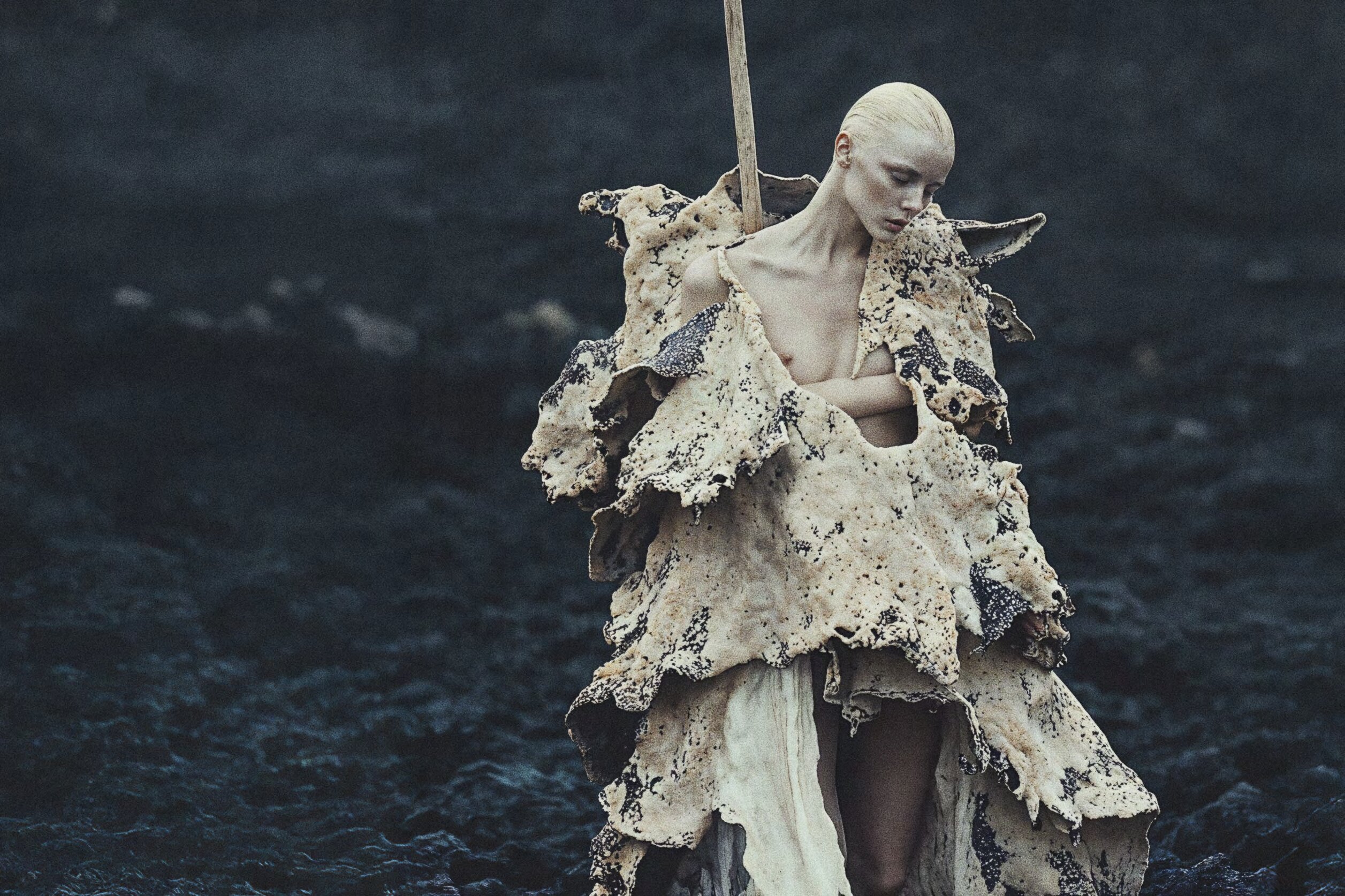
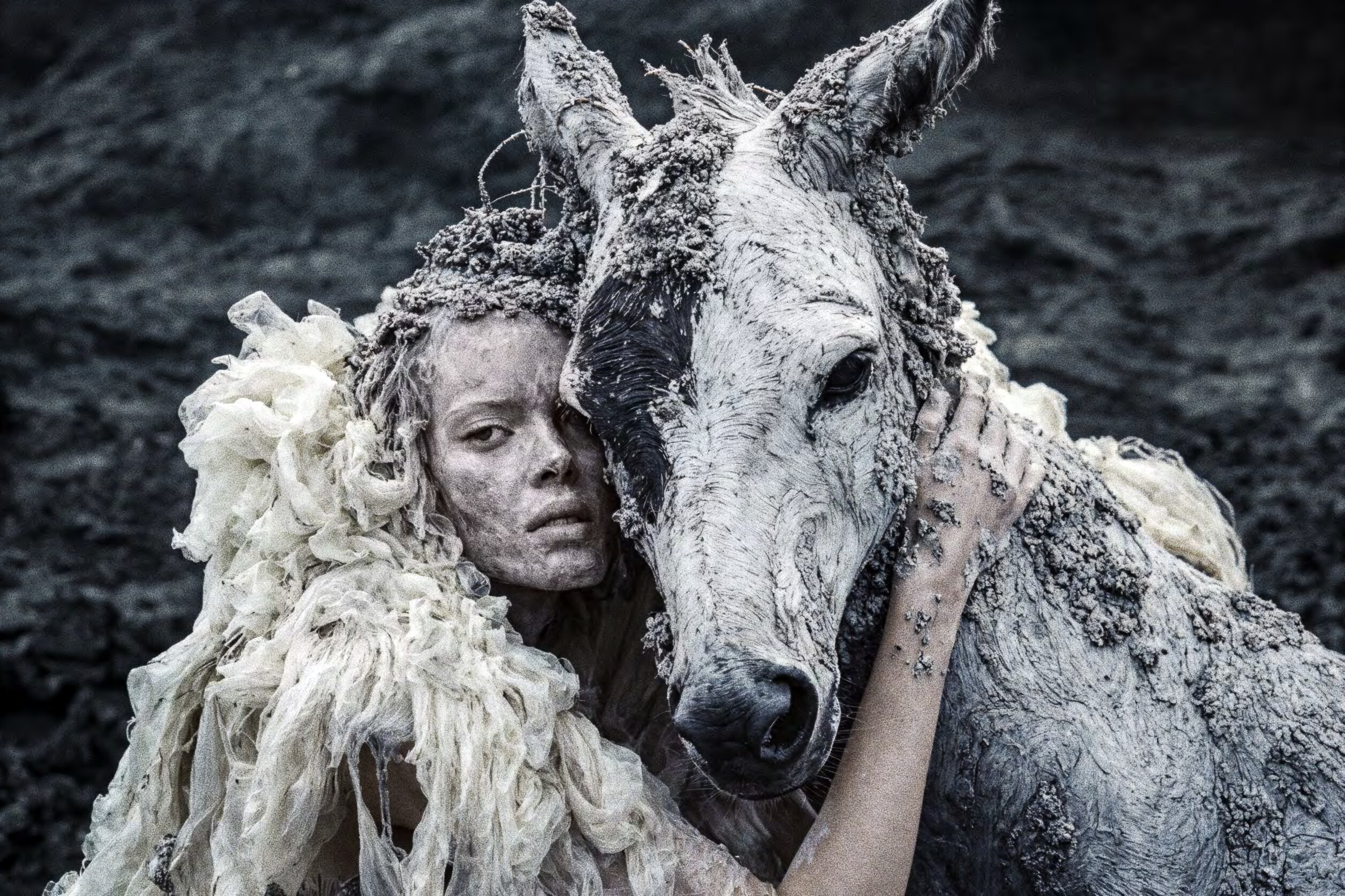
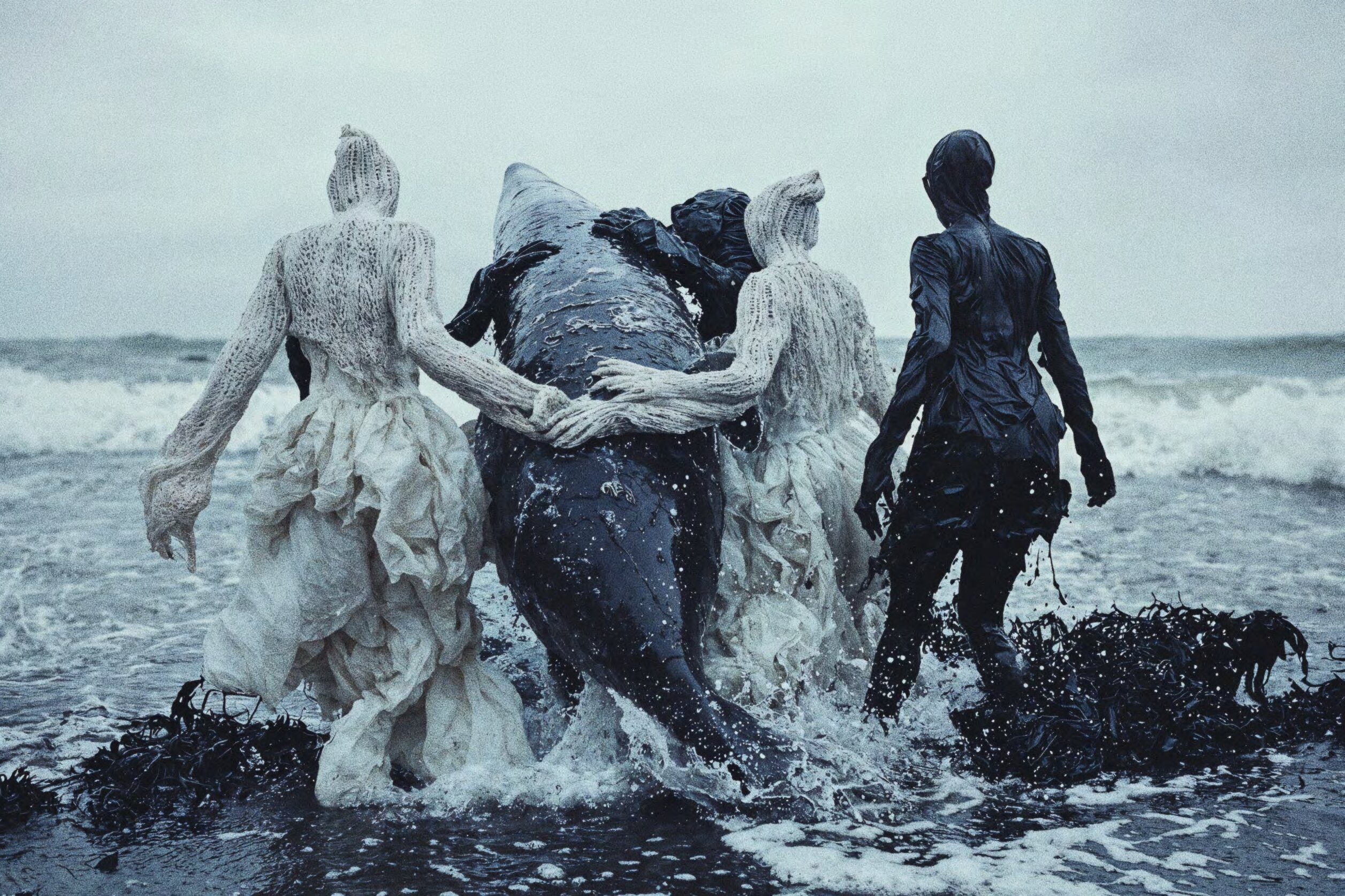
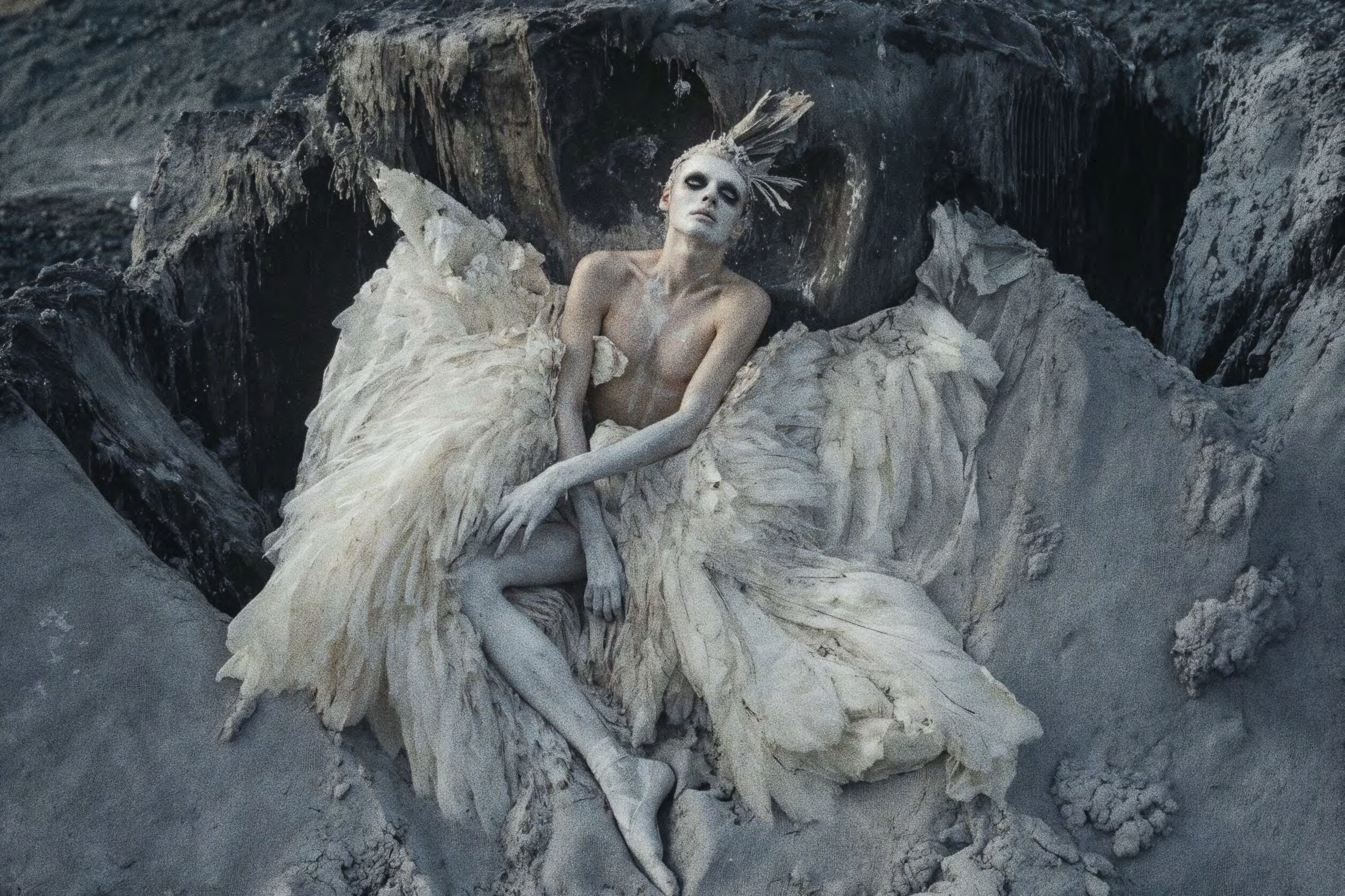
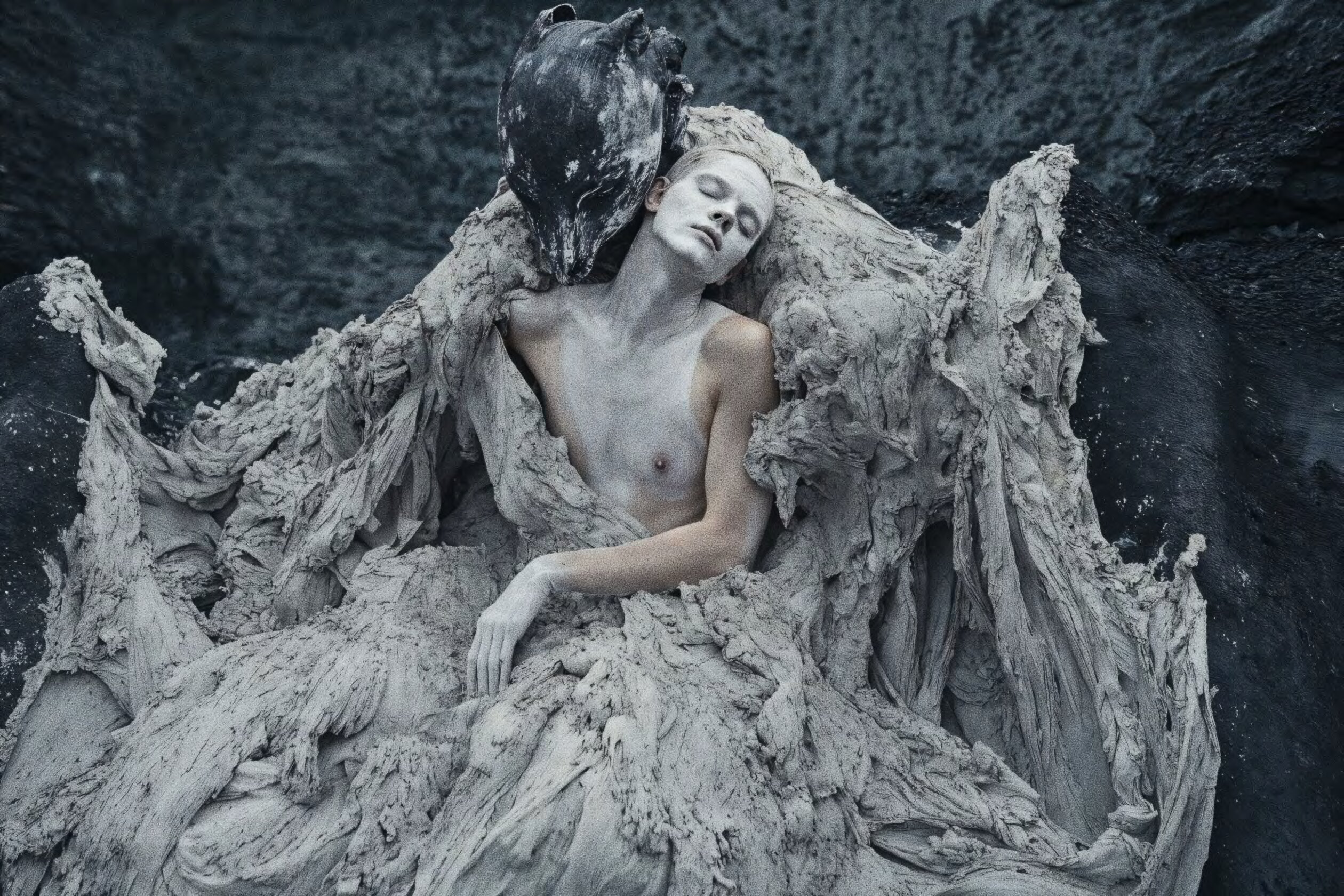
Over the past four years, Swiss-Irish photographer and director Christian Ammann has built an entirely new world. The Mind's Eye is a visual poem set on an imagined volcanic island—a place where ocean and wind roar their harrowing songs to mythical inhabitants, where the endless cycle of birth and death is etched into the terrain and mirrored in its creatures.
What began as a series of AI-generated images—refined through over 60,000 iterations—has grown into a richly layered mythic world, complete with its own spoken and written language, ceramic artefacts, a bespoke fragrance, AI-generated film, and an original sound world. Every element was shaped by Christian Ammann’s nearly thirty years of visual practice.
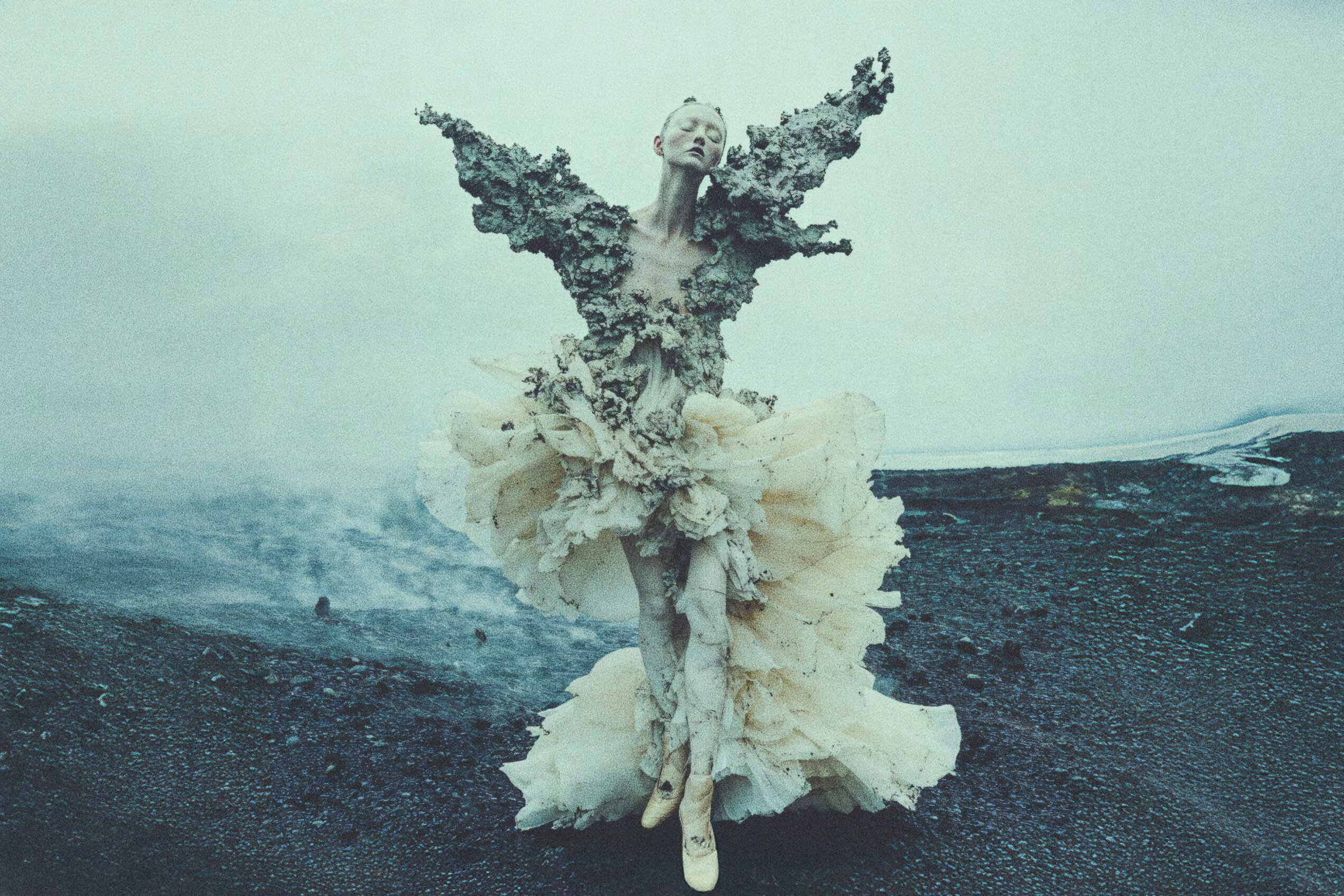
The journey began in June 2022, when Christian Ammann first experimented with AI-generated imagery. The initial results reminded him of the wonder he felt as a young photographer—watching an image emerge in a chemical bath, or witnessing a 4×5 Polaroid develop before his eyes.
But early iterations felt impersonal—echoing others' styles rather than his own voice. This realisation ignited a mission: to merge the boundless possibilities of AI with the heart, soul, and technical precision of an established photographic practice.
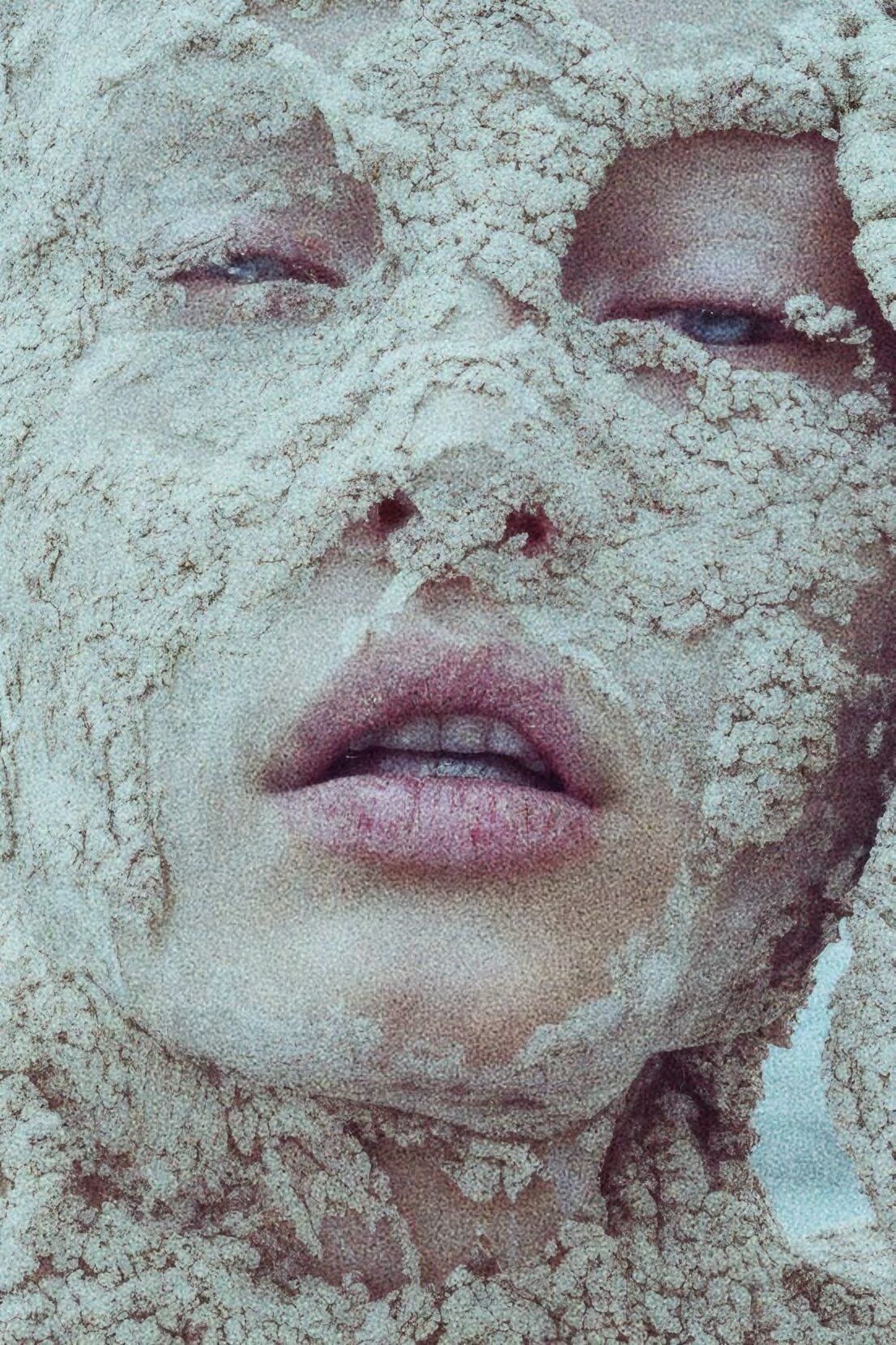
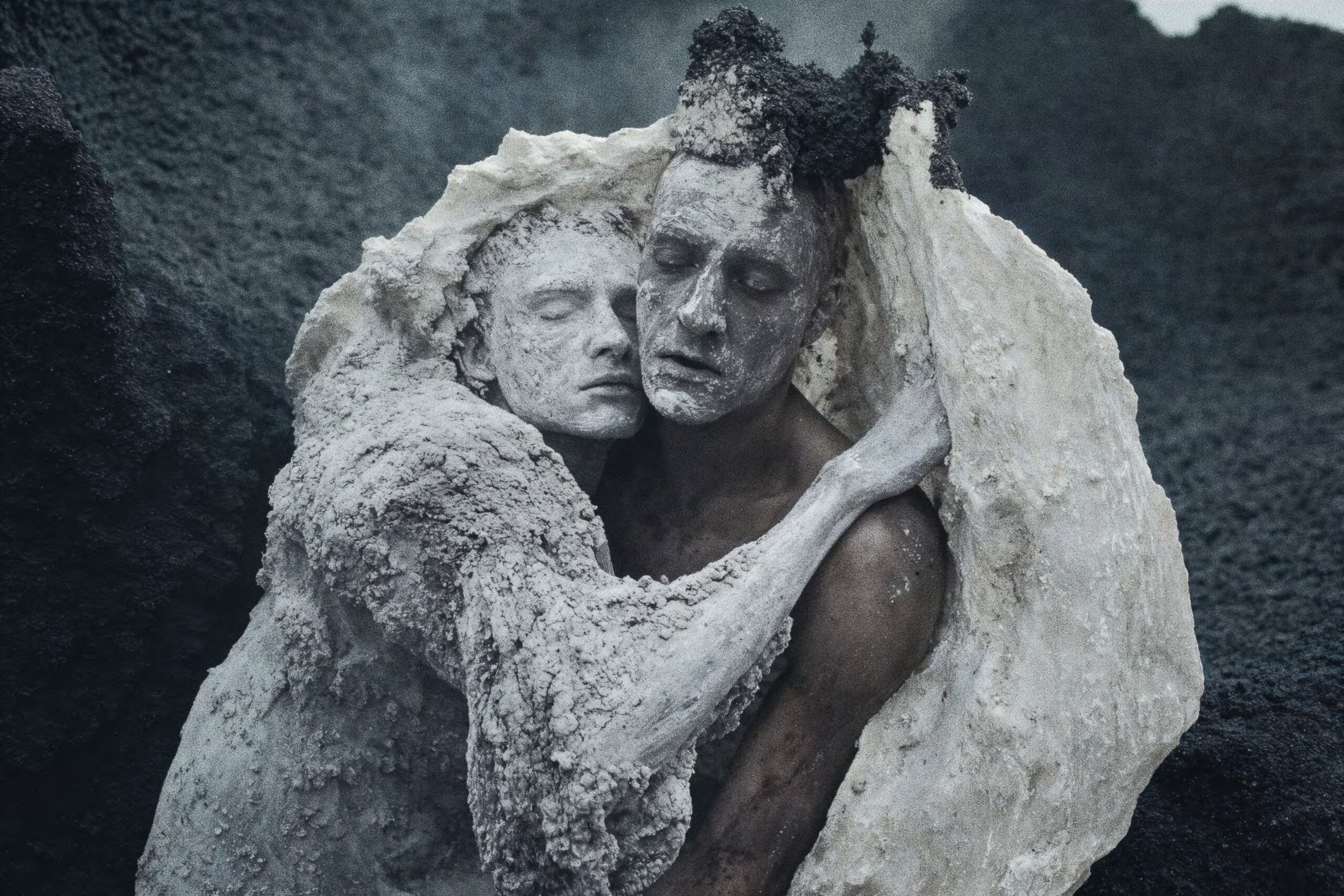
Gods, messengers, and ethereal beings all play their parts—some here to protect, others to prey on lost and searching souls. A profound bond connects the animals and the inhabitants. They are sacred and inseparable.
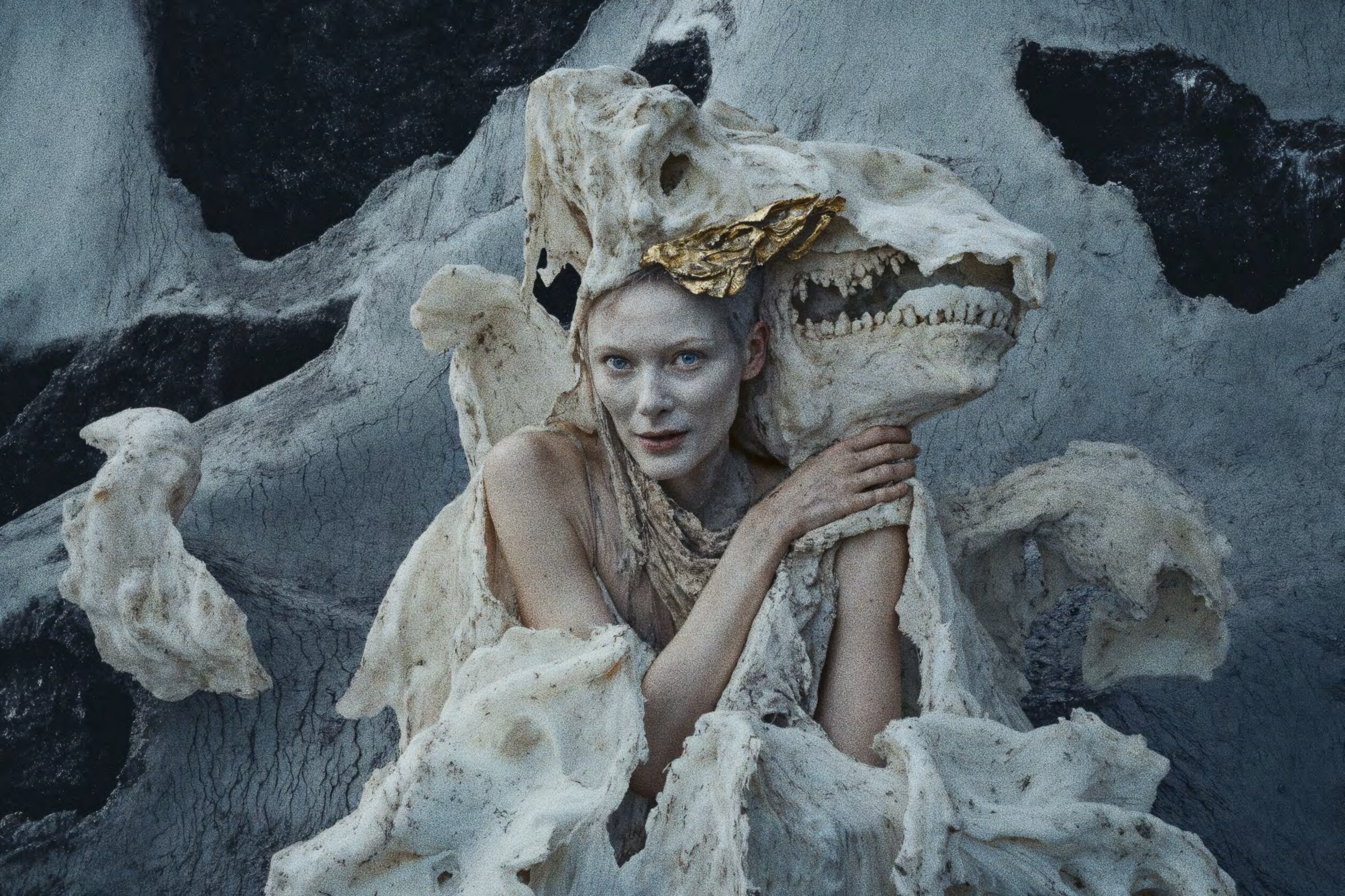
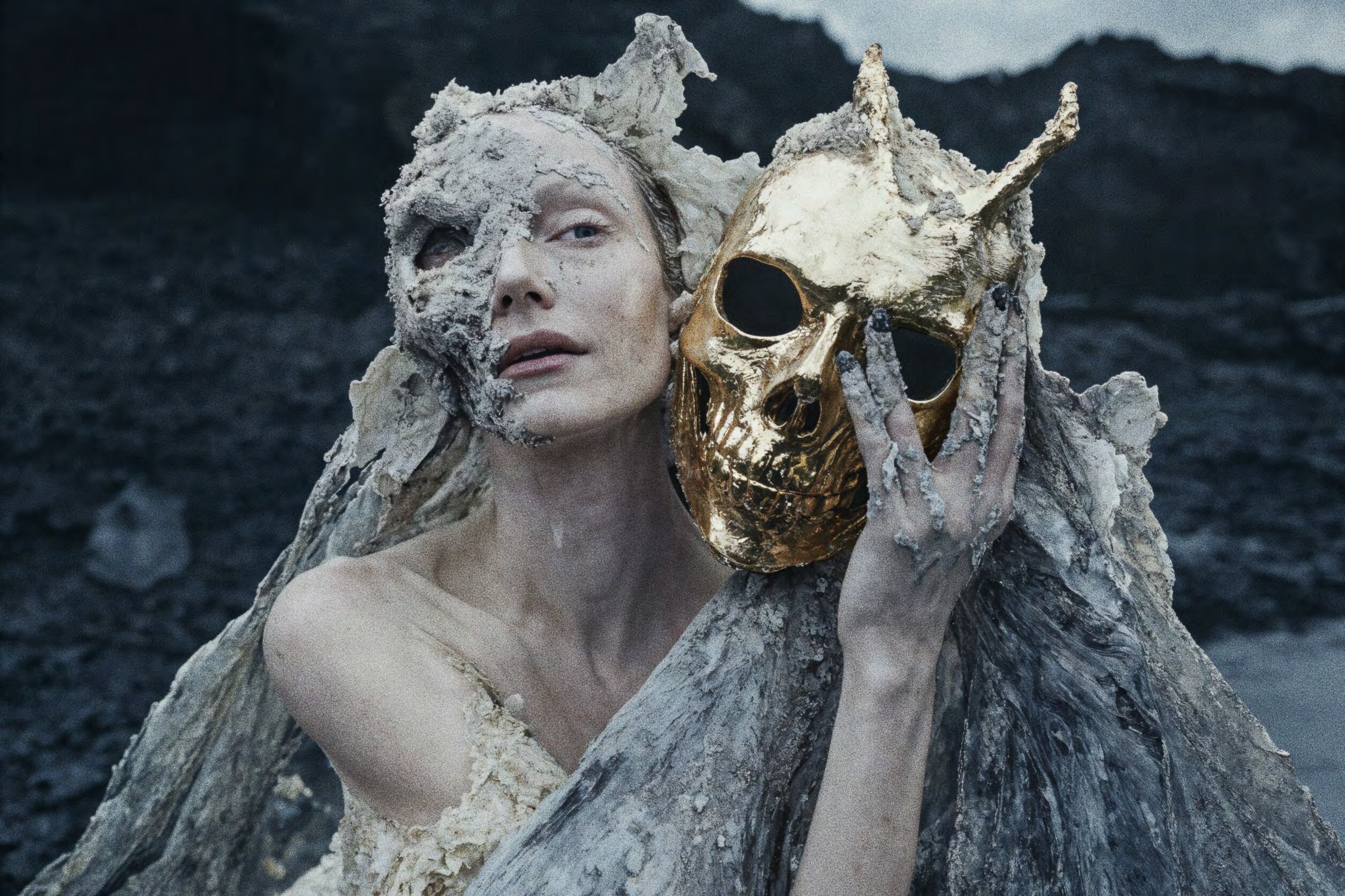
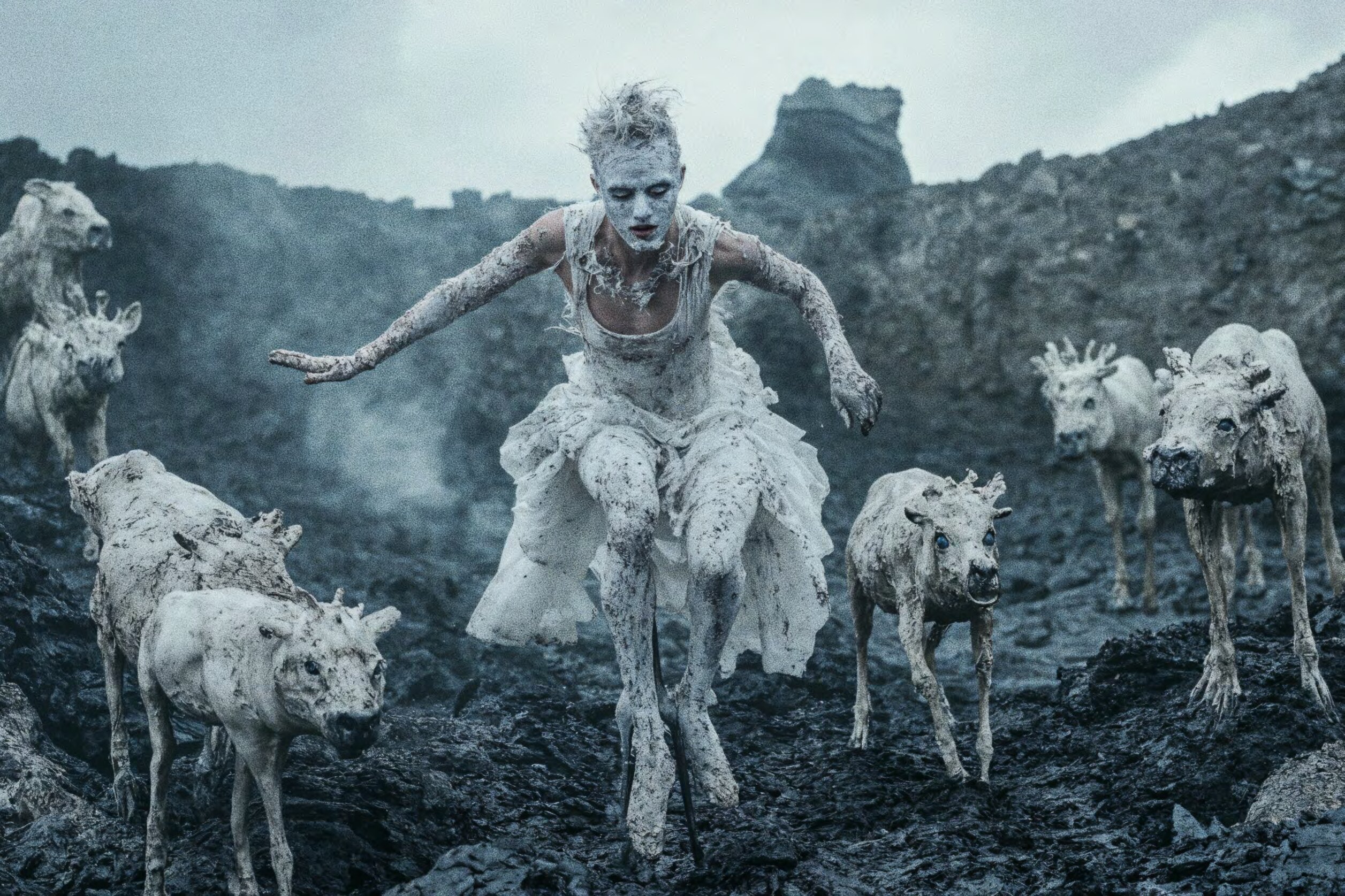
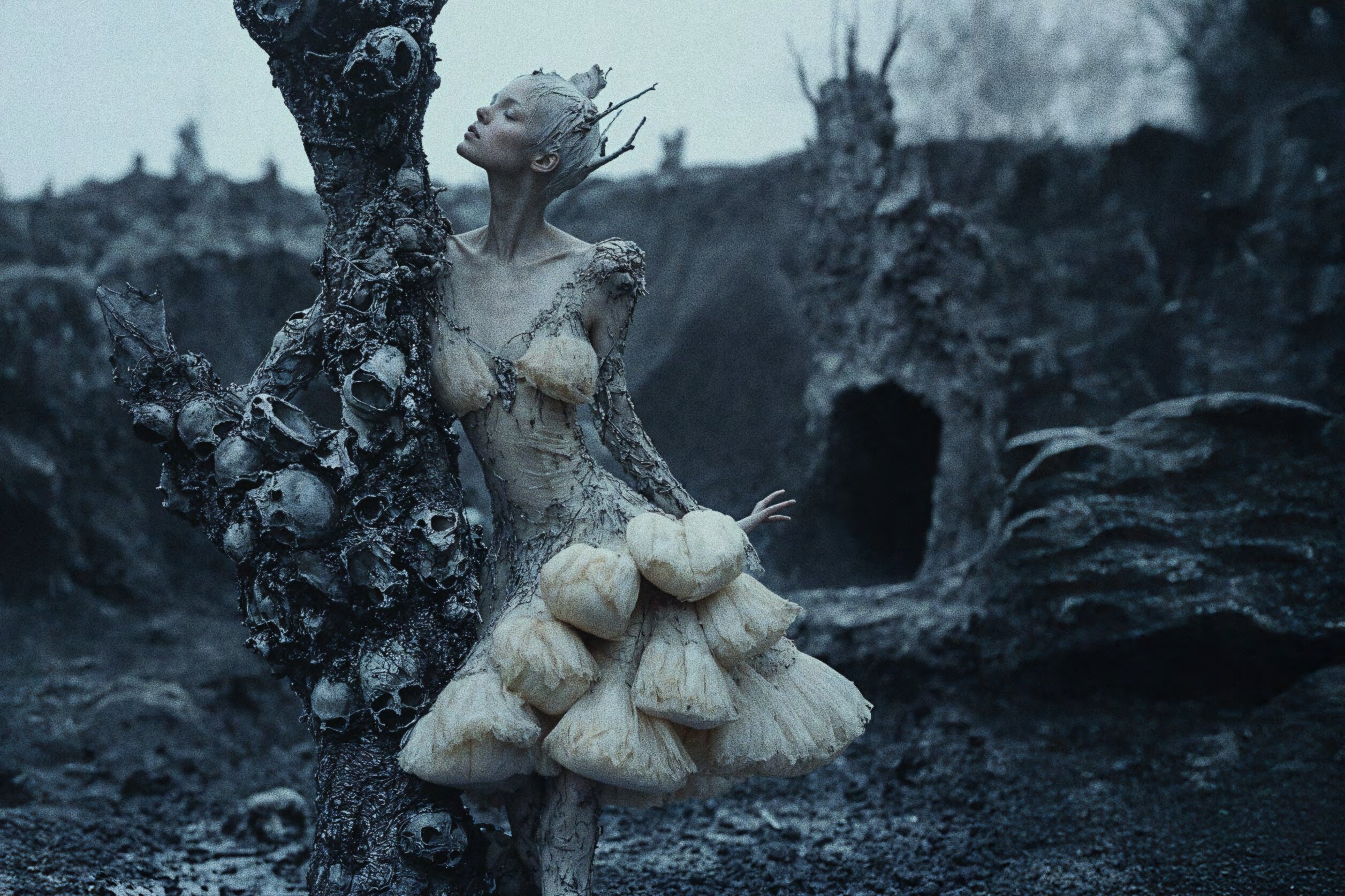
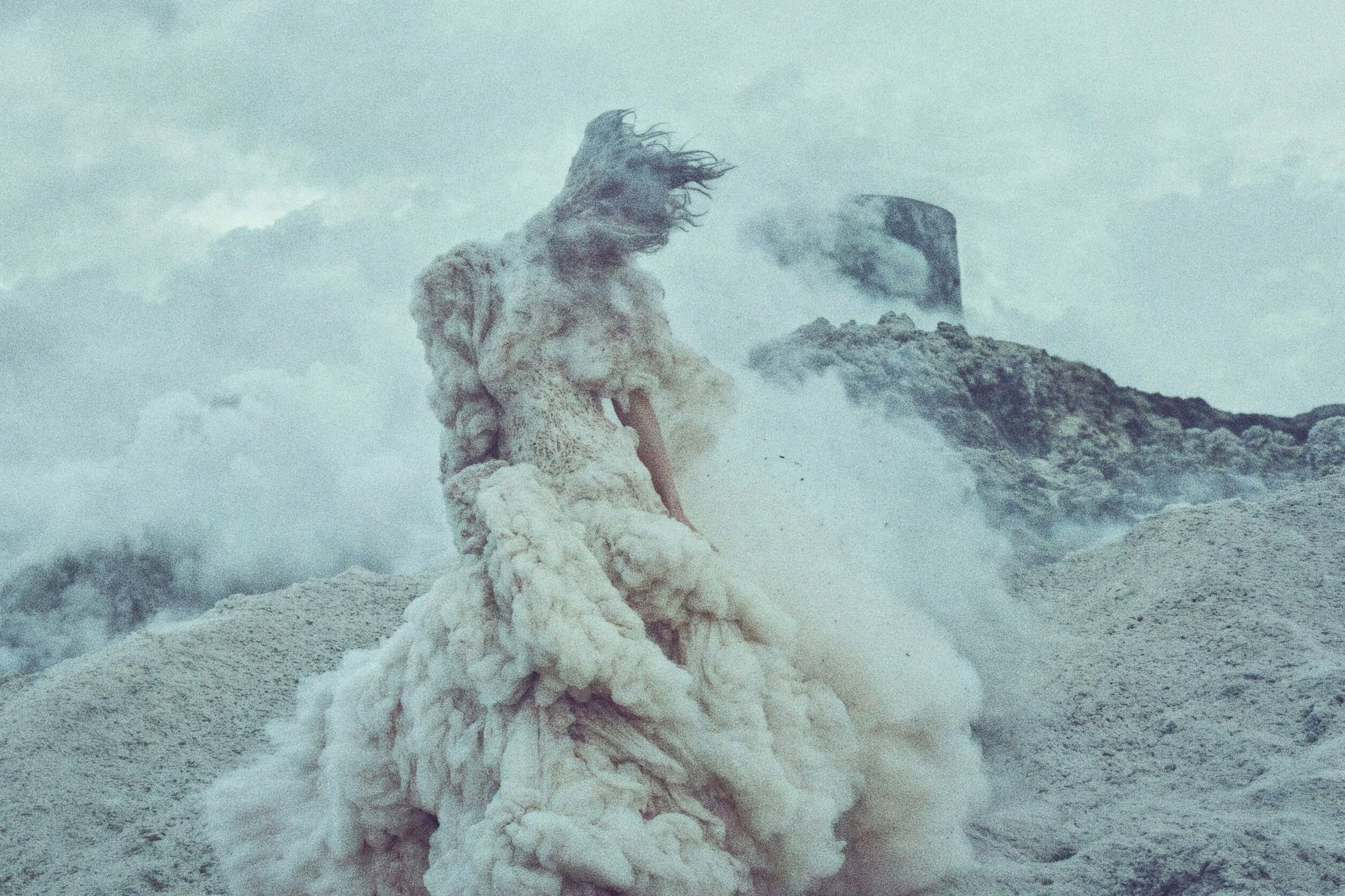
The sea surrounds them, enclosing their lost outpost. From the depths of this vast ocean, fire once rose to create solid ground. Smouldering mountain flanks still bear the marks of the last apocalyptic eruption.
Life in this paradise remains fragile—easily erased by sudden bursts of creation. That is why idols and offerings appear throughout the images—a reminder to appease the destructive force that always lurks nearby.
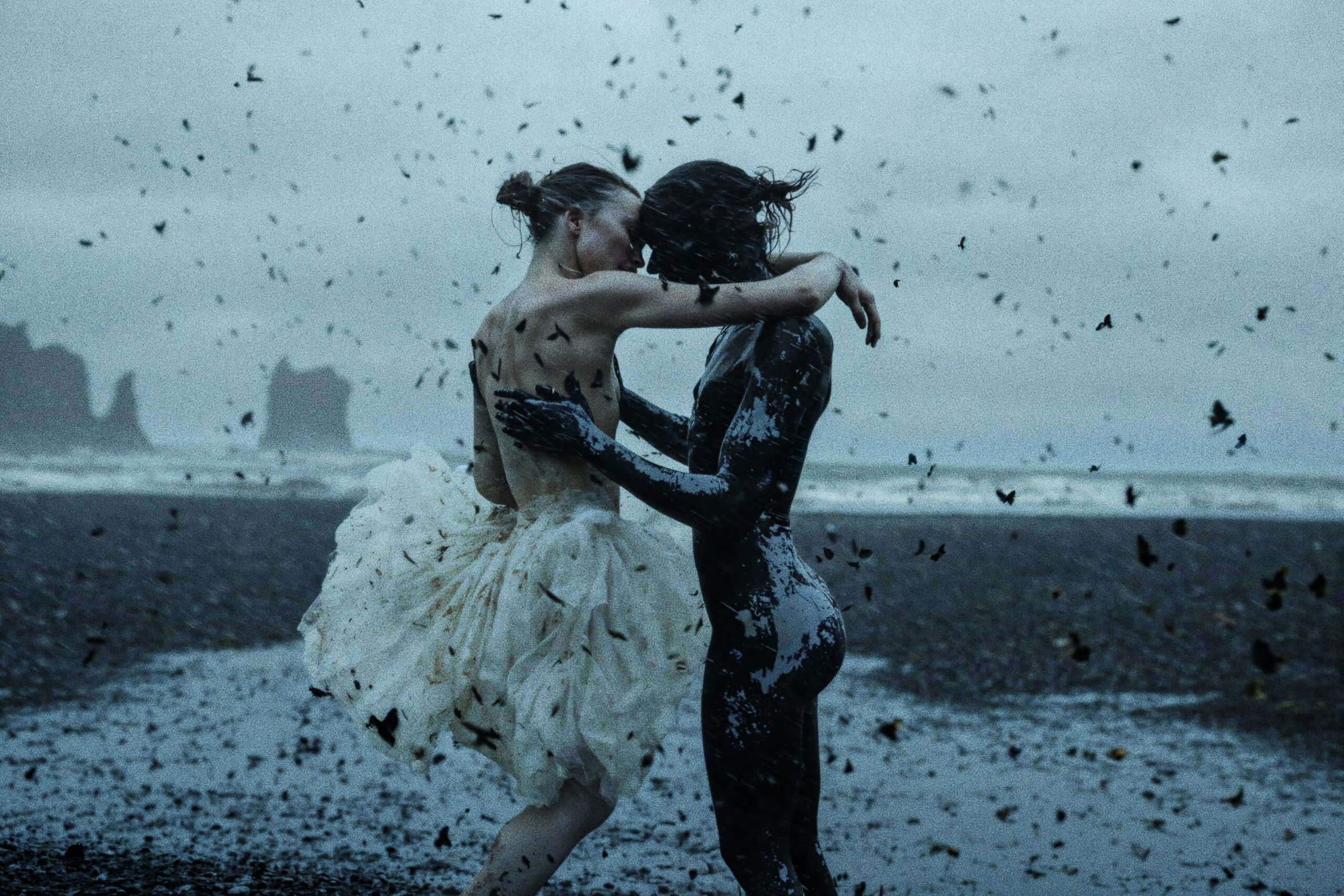
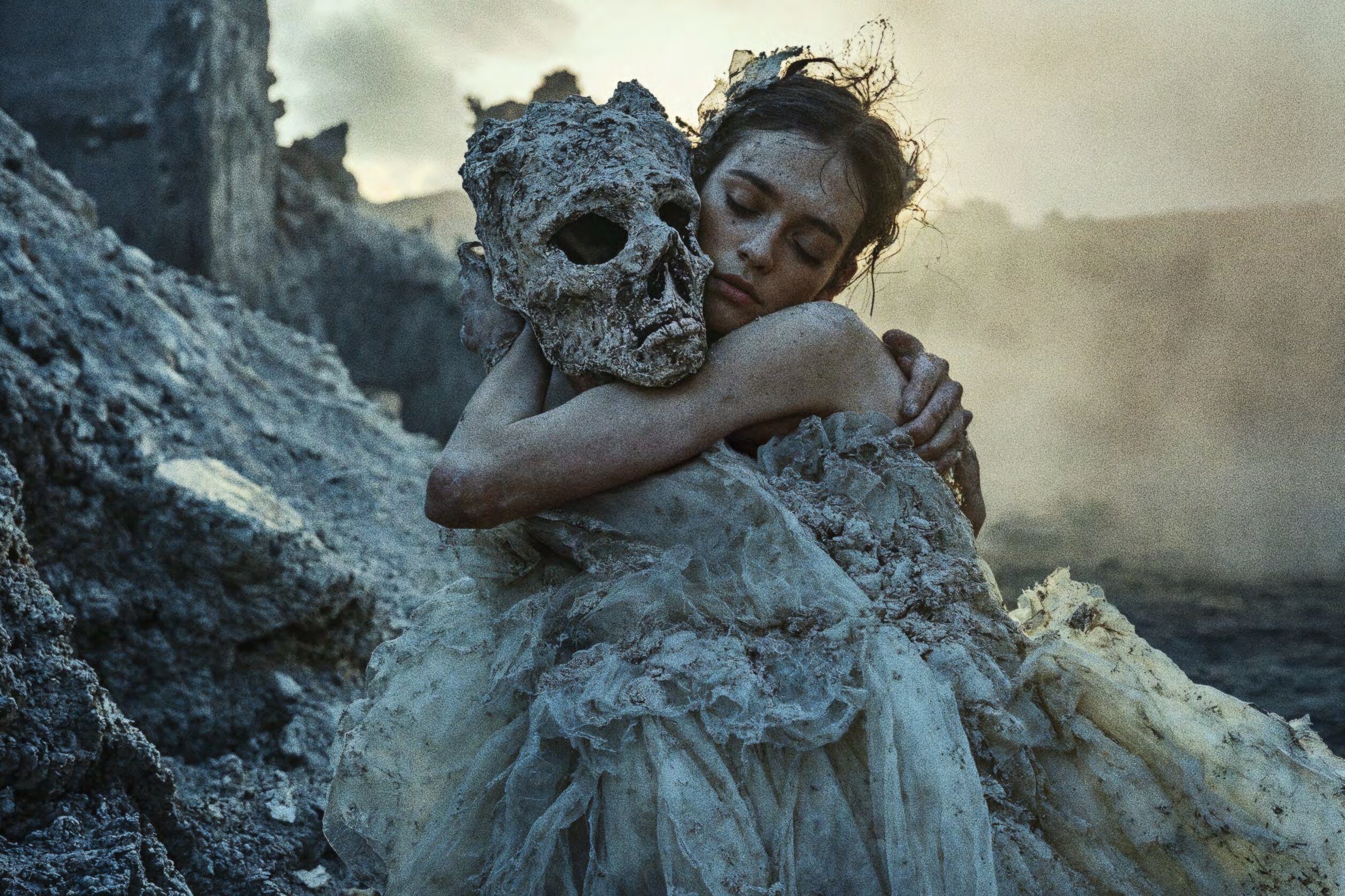
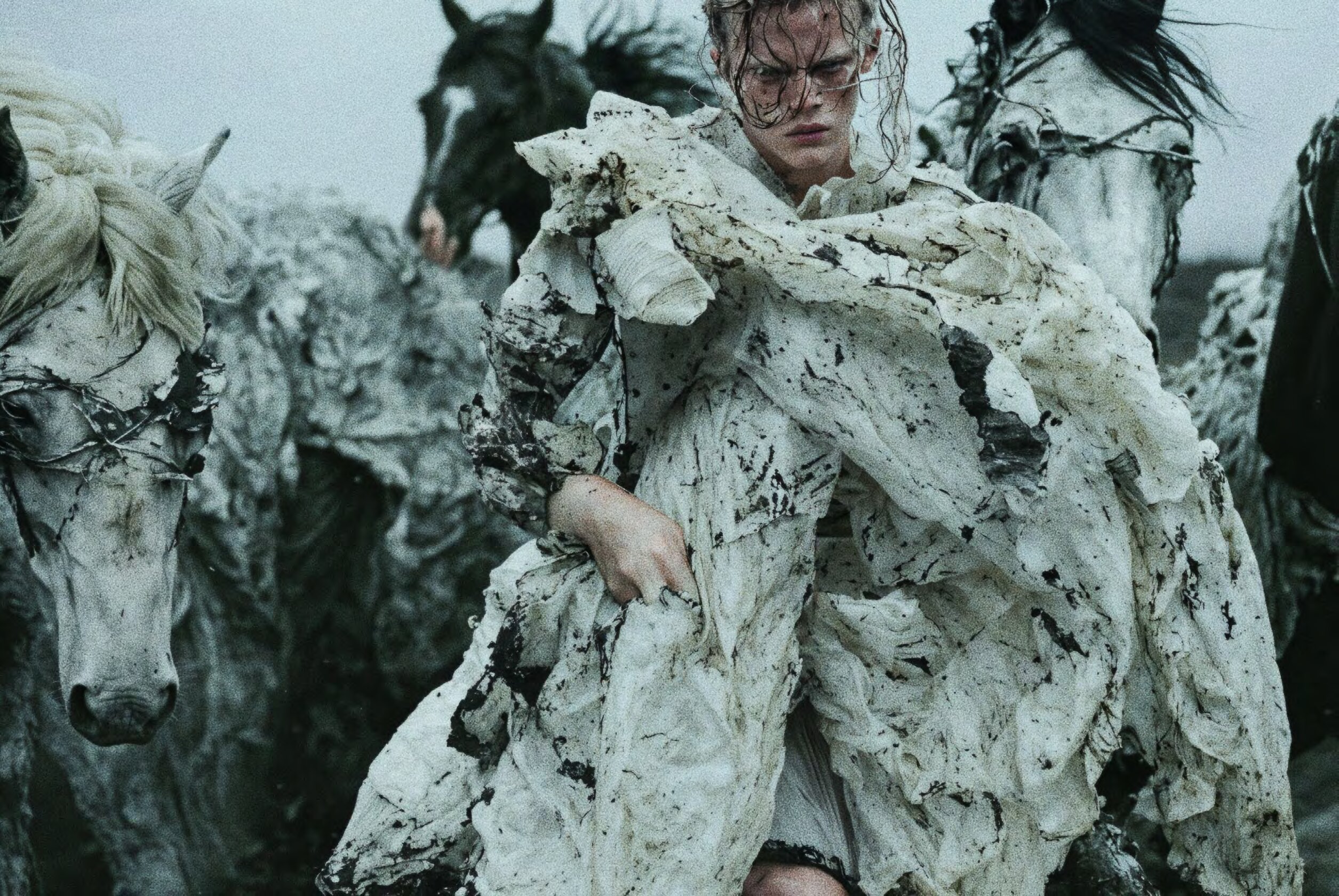
The accompanying filmic pieces trace how archaic existence blossoms into artistic expression—illustrating the genesis of a culture through language and rhythm.
Song of Unison — a collective choral work performed in Lhoqen, where individual voices dissolve into a single resonant body of sound, embodying the tribe's deepest expression of unity.
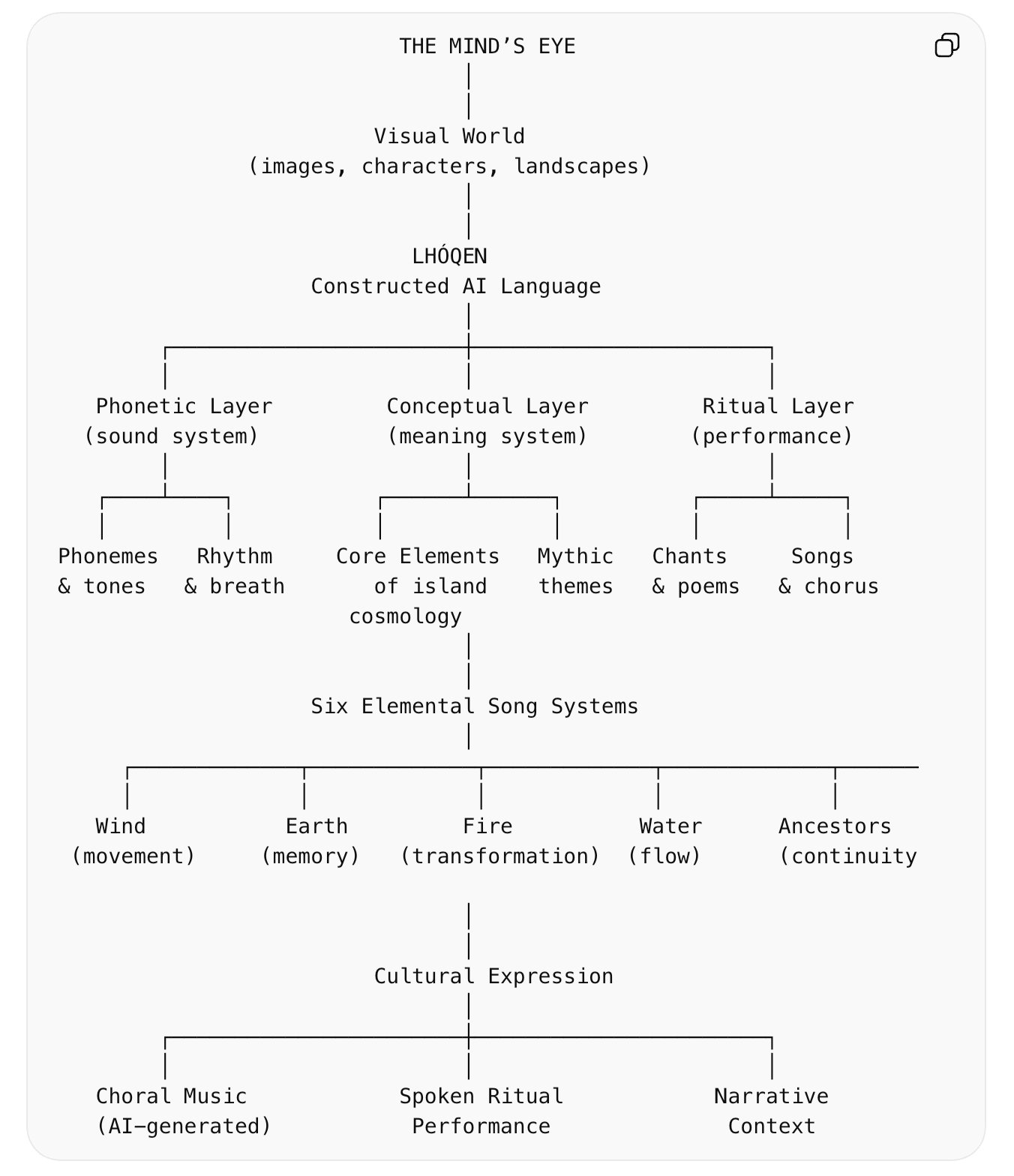
A fully original spoken and written language, created for the island's inhabitants. Lhoqen enables expression through poetry, song, speech, and ritual dance—giving each being emotional individuality while uniting them as a tribe. It has six elemental songs: Wind, Earth, Fire, Water, Ancestor, and the Animals' Promise.
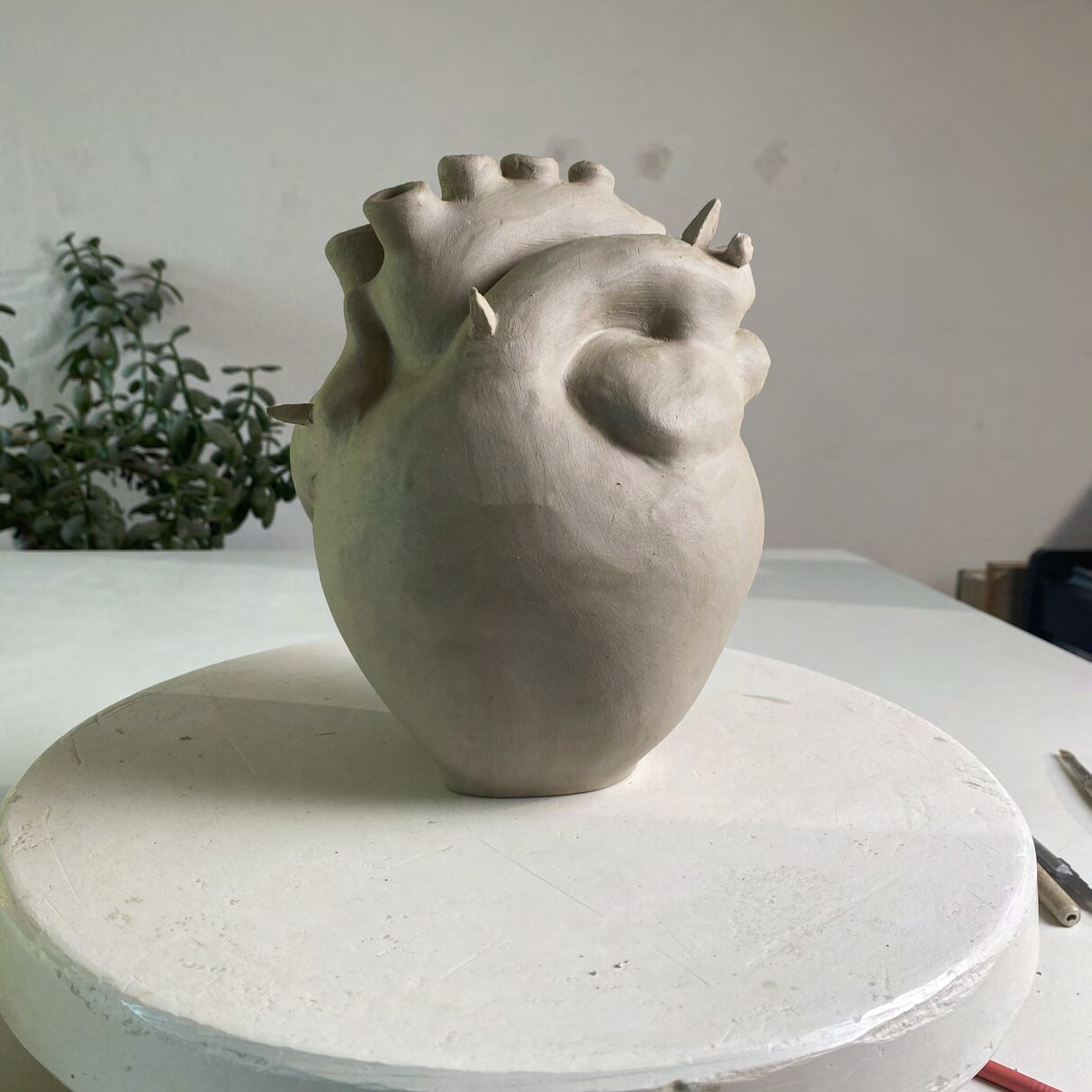
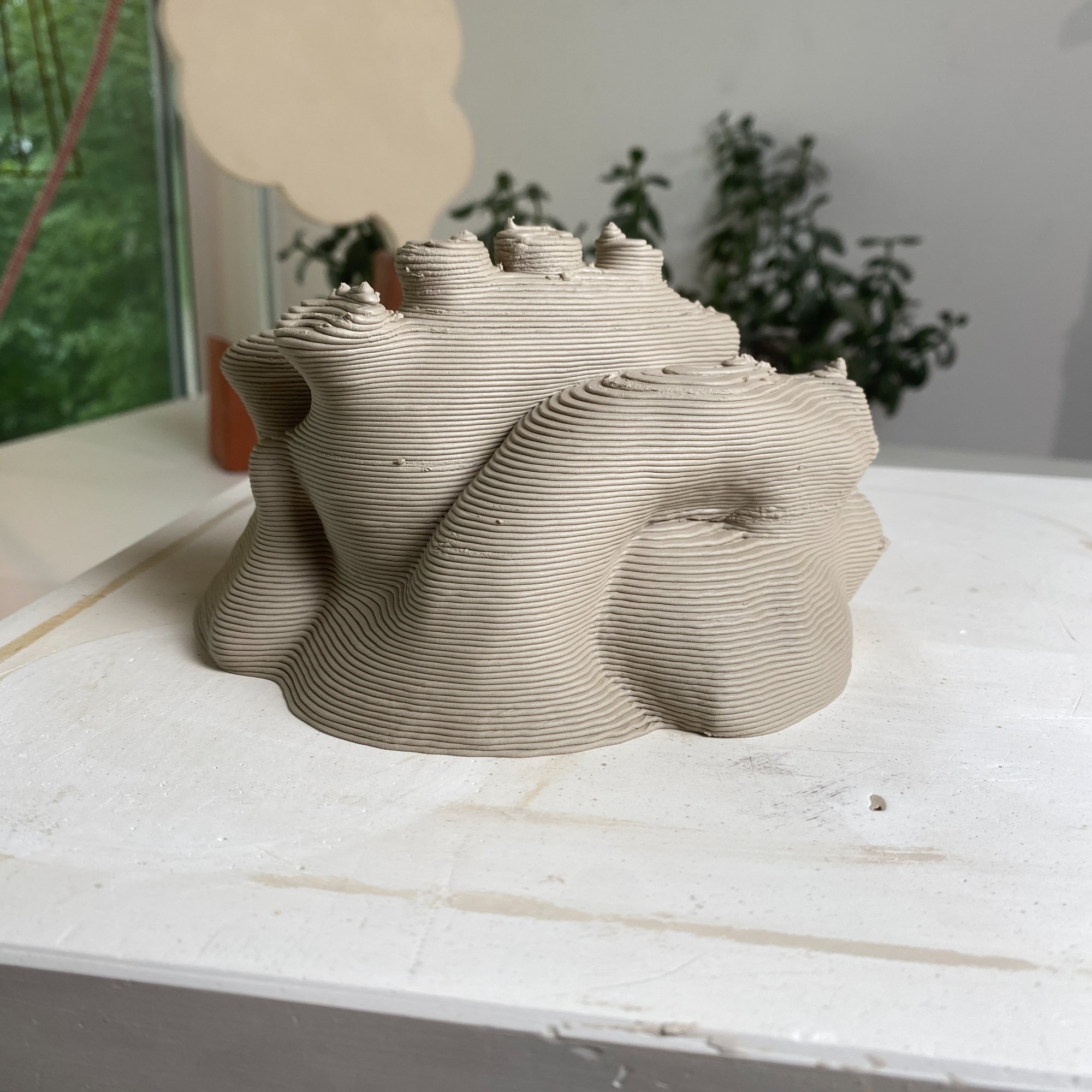
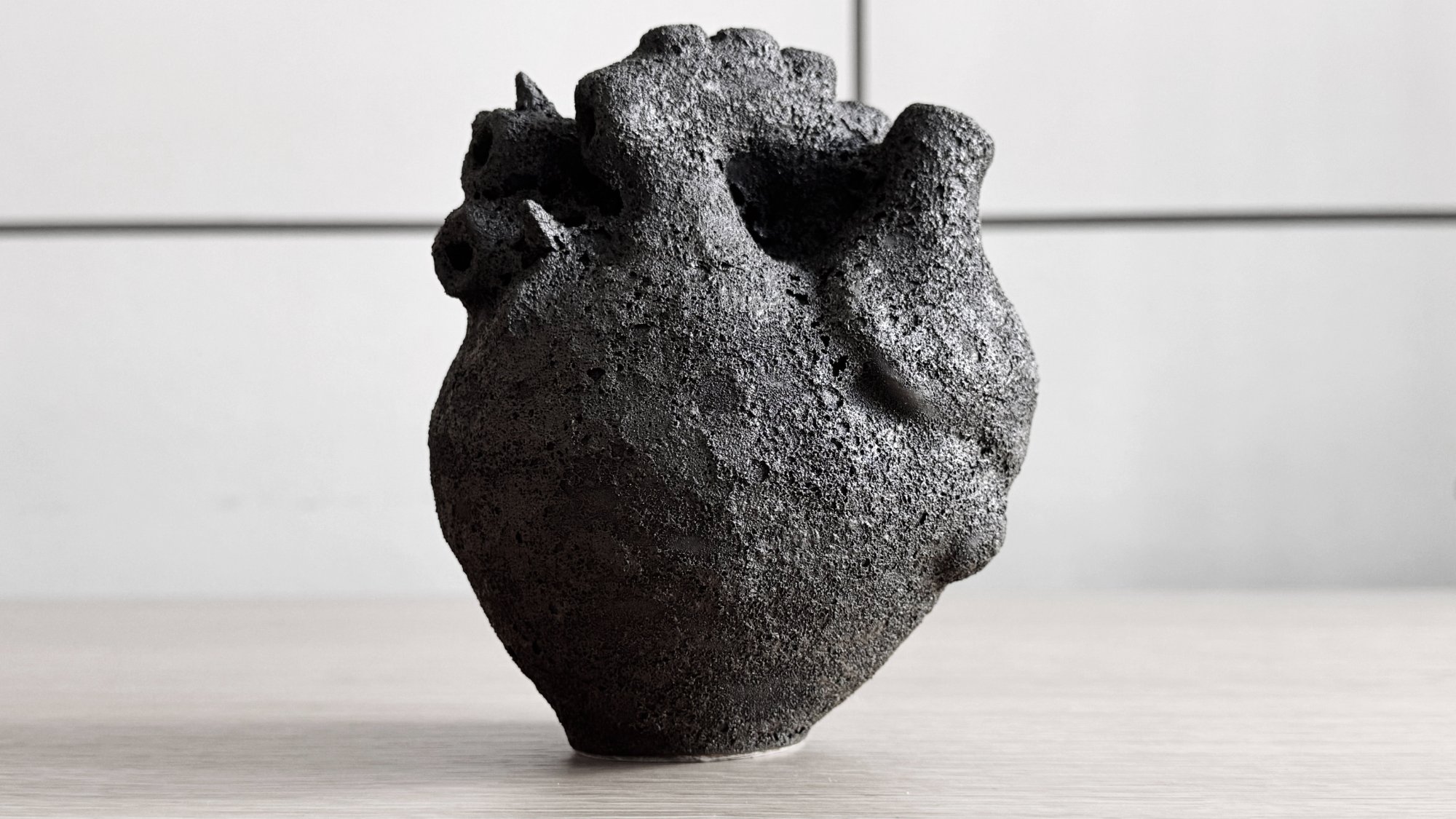
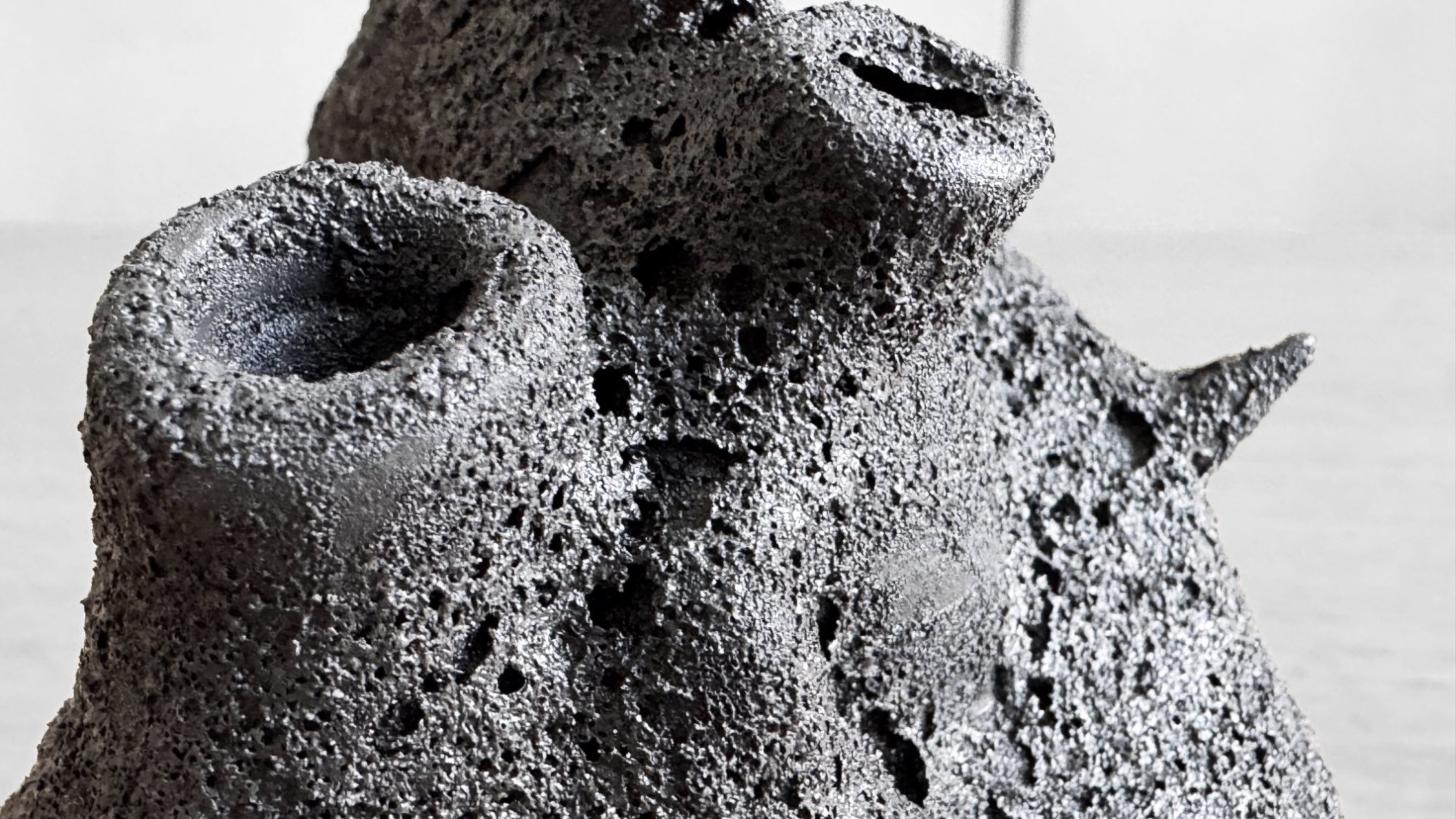
Objects visible within the images have been translated into sculptural ceramic forms using 3D printing and AI-assisted modelling, in collaboration with ceramic specialist Olaf Egner.
A bespoke fragrance co-designed by two AI chatbots, each given an image and the island's history. Their independent creations were merged through dialogue into a hybrid composition, then refined by perfumer Marc Daniel Heimgartner. Its arc: cold ocean, sun-baked clay skin, cooled lava, ash-resin, mineral musk.


Barry Scannell—Irish lawyer, Partner at William Fry, member of the AI Advisory Council of Ireland, Financial Times contributor, and doctoral researcher on AI and copyright—contributes two written reflections that accompany the exhibition:
How can a creator evidence and claim protection when significant human judgment, iteration, and curation drive the work, even though AI contributes materially to the outcome?
How can a creator evidence and claim protection when significant human judgment, iteration, and curation drive the work, even though AI contributes materially to the outcome?
The core artistic question that gave rise to The Mind's Eye was this – "Can I, as an artist, create work that feels and looks unmistakably mine, using AI as intuitively as I use light, camera, and composition?" That question, posed by Christian Ammann, drawing on more than thirty years of practice across photography, filmmaking, and sound curation, is the question that copyright law is now being asked to answer.
Standing in this exhibition, you are surrounded by evidence of an answer. The fragrance was not chosen from a catalogue, but it was generated through a dialogue between chatbots directed by the artist to devise a recipe suited to a specific person depicted in one of the works, with the final formula representing the compromise both systems agreed upon. The ceramics were not thrown on a wheel, rather they were 3D-printed directly from images within the series and then refined and glazed under the artist's direction by ceramic specialist Olaf Egner. The language you hear in the choral compositions, LHÓQEN, does not exist outside this project, it was invented within it, as a system for expressing what the artist describes as non-verbal cognition and emotion, and deployed across every vocal performance, text, and sound composition in the work. Sixty thousand images were generated and after intensive human curation, fifty remain.
The question this essay addresses is not whether all of this is art. You are standing in the answer to that question. The question is whether copyright law, as it currently stands, can see it.
Copyright is the legal mechanism through which societies have chosen to reward and protect creative expression. In its original conception, it was straightforward - a human being produces an original work, fixes it in a tangible medium, and acquires the exclusive right to determine how it is reproduced, distributed, performed, and adapted. The framework was designed for a world in which the relationship between the human creator and the created work was direct and unmediated. The painter's hand moved the brush. The poet's mind formed the words. The composer's ear shaped the melody.
That directness has never been absolute. Artists have always used tools, worked with assistants, and relied on processes that they did not fully control. The darkroom introduced chemistry. The printing press introduced mechanical reproduction. The camera introduced a machine that made creative choices unavailable to the human hand alone. Each of these arrivals required copyright law to ask the same question it is now asking of AI - if the tool is doing the making, is the human still the author?
The consistent answer has been yes, provided the human's creative contribution is present and identifiable in the resulting work. Copyright does not protect ideas. It protects the specific expression of ideas once fixed in a tangible form. What it requires of the human claiming authorship is not that they performed every physical act of production, but that the work reflects their original intellectual creation - that it bears, somewhere in its structure, the imprint of a mind that made choices.
The arrival of generative AI challenges this framework not because it introduces a new kind of tool, but because it introduces a tool whose contribution to the final expression is qualitatively larger than anything that has come before. A camera executes the photographer's framing decision. A generative AI system produces the image itself. The scale of the machine's contribution, and the relative invisibility of the human process that directed it, is what creates the legal problem.
Generative AI works by responding to a prompt - an instruction, typically in text, that the system uses to produce an output. The system that produces the output, not the human who wrote the prompt, is the instrument that fixes the idea in a tangible form. This creates a structural problem for copyright, because in most jurisdictions, the law requires that the person claiming authorship be the one responsible for the expression, not merely the conception.
The "Monkey Selfie" case, decided in the United States, provides an instructive illustration. A photographer set up a camera in the jungle, adjusted its settings, and cultivated a relationship with a group of macaques in circumstances where one of them pressed the shutter and produced a striking self-portrait. The court held that the resulting photograph was not eligible for copyright protection, because the animal, not the human, had performed the act of fixation. The photographer's preparation, intention, and creative context were insufficient, because the decisive act was not his.
A similar principle was applied to a garden in Chicago's Grant Park, where the ultimate colours, textures, and shapes of the planting were held to be dictated by nature rather than by the gardener's choices. The human had planted and tended. The copyright was refused because the final expressive form was not the human's to claim.
Applied to generative AI, this logic suggests that the prompt is the conception and the AI output is the fixation. If the human contributes the prompt and the AI produces the work, the law may conclude that the human did not make the expression, even if the human made every decision that led to it.
The legal world is also beginning to grapple with whether prompts themselves can attract copyright protection. Courts in Asia, including in Shanghai, have distinguished between expressive authorship and functional instruction. A prompt that reads as a creative work in its own right, one that embodies the author's voice, structures language in an original way, and would be recognisable as a literary composition independent of the output it generates, stands a stronger claim to protection than a prompt that functions as a parameterised command. A curated collection of prompts may also attract protection as a compilation, where the selection and arrangement are sufficiently original, even if individual prompts are not.
None of these partial solutions fully captures what The Mind's Eye represents, because The Mind's Eye is not a prompt, and it is not a single output, but rather is a sustained creative project in which human authorship operates at every stage of a process that extends far beyond the moment of generation.
The strength of any claim to authorship in AI-assisted art rests on the demonstrability of the human creative process - the versioning, the prompt trees, the aesthetic direction notes, the selection decisions, the post-processing choices, and the directorial interventions that connect the artist's originating vision to the work that stands in the exhibition.
Consider what that record looks like for The Mind's Eye. The project began with a conception - a visual poem set on a volcanic island, inhabited by mythological figures whose culture, costume, and sacred relationships with animals reflect the artist's long-standing visual and philosophical preoccupations. That conception preceded any prompt. It preceded any AI tool. It was the artistic brief that every subsequent decision was made in service of.
From that originating vision, the artist developed prompts and datasets independently, without reference to the work of other photographers or existing artworks. This is not merely an ethical statement, though it is also that. It is an authorial one. The decision to build a creative process on original aesthetic parameters rather than on the imitation or adaptation of existing work is itself a creative choice, and one that the law, properly applied, should recognise.
Approximately sixty thousand images and numerous video experiments were generated across twenty AI-based tools and five conventional programmes. Each generation produced a set of outputs that the artist evaluated against the originating aesthetic brief. The evaluation was the application of thirty years of trained visual judgment to a vast field of machine-generated possibilities. The artist's eye, moving through sixty thousand images, was performing a critical act that no algorithm could perform in his place, because the standard against which the images were being judged was his, and his alone.
From that evaluation came a further layer of directorial intervention. Film grain was manually added to all media. Chromatic balance and tonal harmony were curated and refined across the entire body of work to ensure visual coherence. Colour grading and lighting direction were applied to the selected works. These are not incidental finishing touches. They are the decisions that make a collection of images a coherent artistic statement rather than an assorted output, and they are the decisions that reflect the artist's personality in the work.
The final corpus, fifty core works from sixty thousand generated, is itself an act of authorship. Curation is not a passive process. The decision of what to keep, and what to discard, is the decision that defines the work. A novelist who produces a hundred draft chapters and publishes twenty is the author of the novel, not merely of the chapters, and the selection is as much a creative act as the writing. The same principle applies here, with the additional dimension that the scale of the curation, the ratio of kept to discarded, has no precedent in conventional creative practice.
Each stage of this process is, in principle, documentable. The prompts can be preserved. The iteration sequences can be logged. The selection decisions can be recorded with timestamps and accompanying notes. The post-processing interventions can be archived with version histories. What The Mind's Eye offers the legal framework that will eventually need to address AI authorship is not merely an argument. It is a model. An artist who works in this way, and who maintains a documented record of the creative process at every stage, is building the evidential foundation for an authorship claim that is as traceable as any human creative process has ever been, and considerably more so than most.
The authorship question in The Mind's Eye is further complicated, and further enriched, by the collaborative dimension of the project. The final exhibition is the product not of one mind but of several, human and machine, working in concert under the direction of a single artistic vision.
The ceramics were not produced by the artist alone. They were 3D-printed from images within the series and then developed in collaboration with ceramic specialist Olaf Egner, whose material and surface expertise shaped the transition from pixel to clay. The fragrance was produced in collaboration with perfumer Marc Daniel Heimgartner, who translated the AI-generated scent composition into a physical reality. The sound layer was composed of AI-generated music and choral structures curated and directed by the artist, with all vocal elements performed in LHÓQEN, the project's invented language. In several works, the imagery was edited in response to the generated sound, creating a reciprocal relationship between the auditory and visual layers in which neither element simply illustrates the other.
This collaborative structure is not unusual in the history of art. Film has always involved directors, cinematographers, production designers, and composers working together under a unified creative authority. Architecture involves architects, engineers, craftspeople, and contractors. The question of who owns what in a collaborative creative work is one that copyright has addressed, if not always satisfactorily, through the doctrine of joint authorship and through the work-for-hire framework. What The Mind's Eye adds to this picture is a new category of collaborator - the AI system itself, which contributed to the generation of images, sound compositions, ceramic forms, and fragrance recipes, but which holds no legal personality, owns no rights, and cannot be a joint author in any jurisdiction currently in operation.
The practical consequence is that where human collaborators have made original contributions to specific elements of the work, those contributions may attract their own copyright protection. Where the AI has generated the expression and the human contribution is one of direction and curation rather than production, the question of protection remains open. But the collaborative structure of The Mind's Eye is also its greatest evidential asset, because it means that the process of human creative decision-making is not the invisible interior experience of a single artist. It is a series of documented exchanges between identifiable people, across identifiable disciplines, over an identifiable period of time, all directed toward a coherent artistic outcome. That record is the authorship claim.
Of all the elements of The Mind's Eye, the invented language LHÓQEN offers perhaps the clearest evidence of the kind of human creative contribution that copyright was designed to protect.
LHÓQEN is a complete linguistic system developed within the project to express what the artist describes as non-verbal cognition and emotion. It is used across every vocal performance, every text element, and every sound composition in the exhibition. It has an internal phonemic structure, a grammar of sound that creates the impression of a real language without being derived from any existing one. It has six elemental songs, each corresponding to a fundamental dimension of the island's world - Wind, Earth, Fire, Water, Ancestor, and the Animals' Promise. These are not categories borrowed from mythology or linguistics. They are the artist's own taxonomy of an invented reality.
The process by which LHÓQEN was developed demonstrates authorship at every level the law requires. It was original, in that no version of it existed before this project. It reflected the artist's personality, in that the phonemic choices, the tonal register, and the relationship between sound and meaning were all determined by the artist's specific creative sensibility. And it was achieved through free and creative choices, in that every aspect of the language, from the sound of individual phonemes to the structure of the elemental songs, was designed rather than generated, chosen rather than computed.
LHÓQEN also illustrates the auditable chain of authorship in its purest form. A linguistic system has internal structure. Its components relate to one another in ways that are traceable and documentable. The development of a language from its originating conception, through its phoneme mapping and grammatical structure, to its deployment in specific vocal performances, is a process that leaves a record at every stage. That record constitutes precisely the kind of versioning and documented creative development that provides the evidential foundation for an authorship claim.
The same principle extends to the other generative dimensions of the project. The sound compositions were generated by AI and then curated and directed by the artist, with imagery in several works edited in direct response to the generated sound. This reciprocal process, in which the visual and auditory layers shaped each other through a series of human directorial interventions, is not a process that can be described as the passive acceptance of machine output. It is a dialogue, and a dialogue leaves traces.
The United States Copyright Office has made clear that it will not register works produced entirely by machines without creative input from a human author. Its guidance identifies the key question as whether a human being made creative choices in the production of the work, and whether those choices are sufficiently reflected in the output. This framework protects the human-authored elements of an AI-assisted work, but it creates a structural gap for works in which the visual or auditory expression was generated by the AI and the human contribution was one of direction, selection, and curation.
The refusal to register Jason Allen's Théâtre D'Opéra Spatial, despite the extensive iterative process Allen had undertaken, illustrates where the US framework currently draws its line. The directorial process, in the Copyright Office's assessment, did not constitute sufficient human authorship in the visual expression itself. This is a significant limitation for artists working in the way that Christian Ammann has worked. It values the act of physical production over the act of creative vision, and in doing so, it misreads where the authorship in this kind of work actually resides.
The European framework, as developed by the Court of Justice of the European Union, offers more analytical flexibility. The test established across a line of significant decisions, most relevantly in Eva-Maria Painer v Standard VerlagsGmbH, asks whether a work is the author's own intellectual creation, whether it reflects the author's personality, and whether that personality is expressed through the author's free and creative choices. This test does not require that the human have performed every physical act of production. It requires that the human's creative identity be present and identifiable in the work.
Applied to The Mind's Eye, the Painer framework produces a compelling analysis. The work is the author's own intellectual creation - it originated from a vision that preceded any AI tool, was guided by aesthetic criteria that the artist developed independently, and was shaped at every stage by decisions that no other artist would have made in the same way. It reflects the artist's personality - the mythology, the language, the tonal universe of the island, and the multi-sensory architecture of the exhibition are not generic outputs. They are the expression of a singular creative sensibility. And that personality is expressed through free and creative choices - the selection from sixty thousand images, the direction of collaborators across ceramics, perfumery, and sound, the invention of LHÓQEN, and the curatorial decisions that brought all of these elements into a coherent whole.
The EU framework has not yet produced a decisive judgment on AI authorship. But the analytical tools it offers are better suited to the reality of AI-assisted creative practice than the US framework's emphasis on the act of fixation, and the direction of travel in the case law suggests that, when the right case is brought before the CJEU, the outcome may be more favourable to the human artist than the current US position would predict.
Even a generous application of the existing copyright framework may not fully capture what The Mind's Eye represents, because copyright was not designed for a creative process of this kind. It was designed to protect the expression of individual human creativity in forms that are directly traceable to the human who made them. The AI-assisted creative process introduces a new kind of authorship, one that is distributed across time, across collaborators, and across the interface between human intention and machine generation, that existing frameworks were not built to accommodate.
The European Union has already recognised, in a different context, that substantial creative investment can deserve legal protection even where it does not meet the classical requirements of copyright. The sui generis database right, introduced by Directive 96/9/EC, protects the maker of a database against the extraction or re-utilisation of its contents, provided that the database represents a substantial investment in its obtaining, verification, or presentation. The protection is not contingent on the database being an original creative work. It is contingent on the investment.
A similar framework, adapted for AI-assisted creative works, could offer a pragmatic solution to the current gap. An artist who has invested substantially in the development of an aesthetic vision, the construction of a creative system for realising it, the curation of machine-generated outputs against original aesthetic criteria, and the direction of a multi-sensory artistic project over an extended period, has made an investment in creative production that the law ought to recognise. Whether that recognition comes through copyright, through a sui generis right analogous to the database right, or through some new form of protection designed specifically for AI-assisted authorship, the investment is real and the case for protection is compelling.
The strength of that case is, in every instance, proportional to the quality of the documentation that supports it. An artist who can demonstrate, through a preserved record of prompts, iterations, selection decisions, directorial interventions, and collaborative exchanges, that every stage of the creative process involved the exercise of human judgment in service of an original vision, stands in a fundamentally different legal position from one who cannot. The documentation is not merely evidence. It is, in a very real sense, the authorship itself made visible.
The volcanic island at the heart of The Mind's Eye is governed by a logic of destruction as a precondition for creation. New land is born from fire. The old is displaced to make room for the new. Its creatures and its people have adapted to conditions of permanent transformation. What appears as catastrophe from one angle appears, from another, as the only available form of renewal.
It is a fitting mythology for an exhibition made in the moment that AI is reshaping the conditions of creative practice. Something is being displaced. The question is what is being born.
What The Mind's Eye offers, beyond the work itself, is a model of how AI-assisted art can be made in a way that builds the evidentiary foundation for authorship recognition. The process is documented. The choices are traceable. The human creative vision is present and identifiable at every stage, from the originating conception to the final installation. The collaborations are explicit, the directorial interventions are recorded, and the auditable chain of human authorship runs from the artist's first question, can I make work that is unmistakably mine using AI as intuitively as I use a camera, through sixty thousand discarded images, an invented language, a negotiated fragrance, and a body of ceramics shaped from pixels, to the fifty works you are standing among.
If copyright law can learn to see this chain, it will not need to choose between protecting human creativity and accommodating the reality of AI-assisted practice. It will recognise that, in the hands of an artist with Christian Ammann's discipline and intentionality, those two things are the same.
The machines did not make this. A human mind did. The machines were its instruments. The documentation is its proof. And the exhibition, in every room and every sensory register, is the argument.
At what point does the act of selecting, combining, transforming, and curating material cross from reproduction into genuine origination?
In a darkened room, a figure stands before an image that should not exist. The face is real and unreal at once. The island behind it was built from mathematics. The garment was grown from a dataset. The silence carries a fragrance that was designed by two artificial minds negotiating a recipe for a perfume suited to someone who may never have lived. The ceramics on the plinth beside you began as pixels and became clay. And yet something speaks. Something insists on being seen.
This is The Mind's Eye, the multi-sensory AI-driven art project conceived and directed by artist Christian Ammann. Over 60,000 images were generated across approximately twenty AI-based tools. From that immensity of output, fifty core works were distilled through processes of curation, iteration, colour grading, tonal direction, and aesthetic selection that the artist describes in terms familiar to any photographer who has ever stood in a darkroom deciding what to keep. Film grain was manually added throughout. An invented language, LHÓQEN, carries the vocal performances. Every sensory element, from scent to ceramic form to choral architecture, was conceived, directed, and chosen by a human artist exercising thirty years of accumulated perceptual discipline.
What the artist has made from what the algorithm provided is not a copy. It is a metamorphosis. The source material, drawn from the vast statistical universe of images on which these systems are trained, has been subjected to a process of conceptual transformation so sustained, and directed by an aesthetic intelligence so specific, that the works before you bear no surface resemblance to anything that training data contained. The island, the tribe, the invented rituals, the sacred animals, the figures who will not meet your gaze - none of this was found. All of it was made. The question this exhibition raises, and that law has not yet answered, is where the making began.
The question has been asked before, by photography, by cinema, by sampling, by collage. Where does copying end and creation begin? At what point does the act of selecting, combining, transforming, and directing become authorship rather than appropriation? And what happens to those questions when the tool doing the combining is not a camera or a mixing desk, but a system capable of generating a universe of images from a single sentence?
This essay addresses those questions through three lenses. The first is cognitive and philosophical - what creativity actually is, where it comes from, and what distinguishes genuine origination from sophisticated recombination. The second is historical - how that question has already been asked and answered, imperfectly, each time a new technology arrived to do what only human hands had done before. The third is legal - how copyright law, developed over centuries to protect the products of human minds, is now being asked to decide whether a mind is still in the room when an AI is holding the brush.
The Mind's Eye does not sit comfortably outside any of these frames. It inhabits all three simultaneously. That is what makes it valuable, not merely as art, but as argument.
Originality is a word that operates differently in law than in common speech. In ordinary usage, it suggests novelty, something never done before. In law, at least in the copyright tradition that has developed across Europe and the common law world, it requires something more specific and, in an important sense, more modest. It requires that a work originate from its author, that it be the product of the author's own intellectual effort, that it carry, however faintly, the imprint of a human mind at work.
The philosopher and cognitive scientist Margaret Boden made a distinction that cuts to the heart of this question. She separated what she called psychological creativity (P-creativity) from historical creativity (H-creativity). P-creativity occurs when an idea is experienced as new and valuable by the person generating it, regardless of whether anyone else has generated that idea before. H-creativity describes something rarer - an idea so entirely novel that no one else, anywhere in recorded thought, has arrived at it previously.
The law, it turns out, has always required P-creativity and not H-creativity. The United States Supreme Court, in Feist Publications v. Rural Telephone Service, offered a clarifying example - if two poets, each ignorant of the other, independently compose identical poems, neither work is novel. Both are nonetheless original, and both are copyrightable. The World Intellectual Property Organisation (WIPO) has made the same point with characteristic precision - two artists painting the same landscape produce works that are not novel, but they are original, because each derives from the painter's own intellectual creation. Novelty belongs to patent law. Originality belongs to copyright. The two are not the same thing.
Transformation sits at the heart of this distinction. A work that merely copies its source is neither novel nor original. A work that transforms its source material through the application of a distinctive creative intelligence, as The Mind's Eye transforms the statistical grammar of its training data into a mythology that no training dataset has ever contained, achieves exactly the kind of P-creativity that copyright was designed to protect. The question is how far transformation must go, and who decides.
H-creativity, the kind that rewrites what is possible for everyone who comes after, tends to arrive in stories that share a common structure. There is a prepared mind, a moment of apparent idleness or interruption, and then a leap that could not have been predicted from any sequence of prior steps.
The apple that fell near Isaac Newton in the orchard at Woolsthorpe is almost certainly apocryphal in its details, but the insight it is said to have prompted was not. While the observation was familiar, objects fall, the leap was extraordinary - the force that pulls objects toward the earth also operates at astronomical distances and holds the moon in its orbit by the same mechanism. That connection, between the mundane and the cosmic, was not derivable by any mechanical process from the observations available to Newton's contemporaries. It required something that the observations alone could not supply.
Archimedes, stepping into his bath and noticing the water rise before his famous Eureka moment, was not the first person to displace water. Every person who has ever entered a bath has displaced water. The insight was the realisation that the displaced volume could measure the volume of an irregular solid. The observation was available to everyone. The connection was available to almost no one.
Albert Einstein, as a young man, posed himself a thought experiment - what would the world look like if you were travelling alongside a beam of light? The question sounds almost childlike. The answer, worked out over years of intense mathematical labour, produced the special theory of relativity. Time is not absolute. These were not conclusions derivable by following existing rules. They required what Boden called impossible surprise, an idea so radical that its very conception demands a departure from the categories available in the existing repertoire of thought.
What connects these examples is not that they arrived from nowhere. Newton had read Galileo and Kepler. Archimedes had studied geometry. Einstein had mastered the mathematics of his day. The leap, in every case, was made from a platform of accumulated knowledge, but the leap itself was not contained in that knowledge. Something crossed a gap that pure accumulation could not bridge.
Boden identified three registers of surprise that creativity can achieve. A work may be statistically surprising, bringing together unrelated ideas or domains in ways that are unusual, as a metaphor in poetry imports the logic of one field into the emotional territory of another. It may produce the shock of recognition, where an unexpected idea fits so precisely within an existing structure of understanding that the surprise and the satisfaction arrive simultaneously. Or it may produce impossible surprise, the idea so genuinely new that it restructures the field it enters. The question that AI poses, and that The Mind's Eye makes urgent, is whether a machine can produce impossible surprise, or whether it can only traverse the territory that its training data has already mapped.
In January 1815, the poet George Gordon, Lord Byron, married Annabella Milbanke. The marriage was tempestuous and brief. In December of that year, Lady Byron gave birth to a daughter named Augusta Ada, whom Byron called Ada. The following month, Lady Byron left the family home. In April 1816, Byron signed the deed of separation and left England permanently, playing no further part in his daughter's life. He died in 1824, when Ada was eight years old.
Lady Byron was determined that her daughter would not inherit her father's volatility, his recklessness, and what she regarded as the dangerous romanticism of the poetic temperament. She promoted Ada's education in logic and mathematics, believing these to be antidotes to the disorder of poetry. The strategy did not entirely succeed. Ada, who became Lady Lovelace upon her marriage to William King in 1835, wrote to her mother with characteristic wit - if poetical philosophy was to be denied her, might she at least have poetical science?
Ada Lovelace's private tutor, the mathematician Mary Somerville, introduced her to Charles Babbage, today regarded as the conceptual father of the computer. Babbage had designed the Analytical Engine, a mechanical calculating device of extraordinary ambition. In 1840, Babbage gave a series of lectures on the Engine at the University of Turin, where the Italian mathematician Luigi Menabrea transcribed his notes in French. Lovelace was commissioned to translate Menabrea's account into English. There is an irony in this that Lovelace herself might have appreciated - her foundational contribution to computer science was itself an act of transformation. She took another scholar's transcription of another scholar's lectures and, in translating it, produced annotations that were substantially longer than the text she was translating and that contained what is now widely regarded as the first computer programme. The translation became something new. The derivative work became the original one.
Lovelace saw in the Analytical Engine something that Babbage himself had not fully articulated. Babbage conceived his machine primarily as an instrument for computing mathematical tables. Lovelace understood that any symbolic operation could, in principle, be expressed in the Engine's language, including the composition of music. She wrote, with remarkable prescience, that if the fundamental relations of pitched sounds in the science of harmony were susceptible of such expression, the engine might compose elaborate and scientific pieces of music of any degree of complexity or extent.
And yet, for all her creative insight, Lovelace drew a firm boundary. The Analytical Engine, she wrote, had no pretensions to originate anything. It could do whatever humans knew how to order it to perform, but no more.
This is Lady Lovelace's Objection, and Alan Turing identified it as the most serious challenge to his thesis that machines could think. In his landmark 1950 paper proposing what became known as the Turing Test, Turing addressed the objection directly, noting that machines could surprise him routinely through the unexpected consequences of the instructions they had been given. But Turing went further. He challenged the assumption that human creativity was itself genuinely original, asking who could be certain that the original work he had done was not simply the growth of a seed planted by teaching, or the effect of following well-known general principles.
This is the crux of the matter. If human creativity is itself a form of sophisticated recombination, trained on the accumulated outputs of prior minds, then the distinction between the human creator and the machine learning model begins to appear less stable than copyright law has assumed. If P-creativity is all the law requires, and if P-creativity can in principle be achieved through processes that do not involve a biological nervous system, then Lady Lovelace's Objection is not a wall. It is a question.
The Chinese boardgame of Go is considered the most complex game ever conceived by humans, where stones are placed on a board and the object is to surround your opponent. On 12 March 2016, in the second game of a five-match series between the artificial intelligence programme AlphaGo, developed by DeepMind, and the world champion Go player Lee Sedol, AlphaGo made the 37th move of the game. It placed a stone in a position that professional Go players watching the game initially described as a mistake. Lee Sedol left the room. He later said he needed a moment to compose himself. He described the move as beautiful.
Move 37 was not a move that any human player would have made. It violated conventions that had governed high-level Go play for centuries. It was not derivable from the training data on which AlphaGo had learned the game. AlphaGo estimated, at the time of the move, that a human player would make it roughly one time in ten thousand. And it worked.
The move has since been discussed by AI researchers as a candidate for the first genuine example of machine H-creativity - not the recombination of known patterns in a statistically sophisticated way, but a departure from the available repertoire that restructured the understanding of the field it entered. Professional Go players subsequently incorporated the logic of Move 37 into their own play. AlphaGo had taught them something about a game that had been played for 2,500 years.
When technologists speak of artificial general intelligence, or of superintelligence, what they mean at its core is a system capable of consistent H-creativity, one that can cross the gap, not merely map the territory. We are not there yet. The systems used in the making of The Mind's Eye are extraordinarily capable instruments of P-creativity. They recombine, synthesise, interpolate, and respond in ways that are experienced as new and valuable by those working with them. Whether what they produce can constitute impossible surprise, as a general capacity and not merely as an emergent accident, remains genuinely uncertain.
What is no longer uncertain is that the boundary between P-creativity and H-creativity in machine systems is less fixed than it was when Lady Lovelace wrote her notes on the Analytical Engine. That boundary is moving, and copyright law is watching it move without yet having decided what to do about it.
The history of creativity is, in significant part, a history of new tools arriving to do what only human hands had previously done, and of the period of disruption and liberation that followed. Photography is the paradigm case, and its lessons are directly legible in this exhibition.
Before the daguerreotype was announced to the world in 1839, the making of a portrait was an act that required years of technical training, an intimate understanding of light and pigment, and a sustained physical encounter between artist and subject. Portrait painters were essential, not merely as artists, but as the only available technology for producing a permanent visual record of a human face.
When photography arrived, it did not destroy painting – it liberated it. The obligation to be a faithful recorder of visible reality, which had constrained portraiture for centuries, was lifted. Artists who had spent careers mastering the representation of what was in front of them were suddenly free to ask what else their skills could do. The consequences were extraordinary. Impressionism, which emerged in the 1860s, departed from photographic precision to capture the phenomenology of looking - the shimmer of light on water, the blurred energy of a crowd, the way a cathedral changes colour through the hours of a day. Cubism, developed by Picasso and Braque in the first decade of the twentieth century, asked what it would look like to represent an object from multiple viewpoints simultaneously. Art Nouveau reimagined the decorative traditions of the natural world. Expressionism turned inward to the distortions of emotional experience. None of these movements were possible while painters were still needed as a portrait technology.
Photography also democratised the capacity to produce images. For the first time, a person without the years of training required to paint could nonetheless fix a visual record of the world. The question this raises, which has never been answered to anyone's satisfaction, is how many artists the world missed because they were born too poor to afford a teacher, or too distant from any centre of learning to acquire the skills of representation. How many Mozarts never had access to a piano? How many Shakespeares never learned to read? A technology that lowers the barriers to creative practice does not diminish the creative tradition. It expands the number of people who can contribute to it.
AI image generation is, in this respect, a new chapter in a story that photography began. It offers access to visual creation to people who could not previously produce images with any technical sophistication. It also, as The Mind's Eye demonstrates, offers experienced artists a new instrument of extraordinary expressive range, one capable of generating iterations at a scale, and across a tonal and formal register, that no single human working with conventional media could match. The critical ethical condition on which that instrument depends, and on which the legitimacy of works made with it rests, is that the training data underlying these systems is handled responsibly. The authorship question and the data integrity question are not separate. An artist who builds a creative practice on tools trained without proper accountability for the rights of the works they consumed occupies a different ethical position from one who is attentive to those questions. The Mind's Eye addresses this directly - prompts and datasets were developed without reference to the work of other photographers or existing artworks, ensuring, so far as the artist could control it, that the transformative process built on a foundation of creative integrity.
The legal questions that photography raised have never been fully resolved either. In Burrow-Giles Lithographic Co. v. Sarony, the United States Supreme Court in 1884 concluded that a photograph of Oscar Wilde was copyrightable because the photographer had made specific creative choices in arranging the subject, the lighting, and the composition. The photograph was not the automatic product of a machine. It was the product of a mind exercising judgment. That reasoning has proved durable, and it maps directly onto the questions that AI-assisted art now poses.
Before reaching the courtroom, the question of where copying ends and creation begins passes through a conceptual territory that law has always struggled to map with precision. A derivative work, in copyright terms, is one that is based on or adapted from a pre-existing work. It requires authorisation from the rights holder of the original and, if sufficiently original in its own right, acquires its own copyright protection. A transformative work, particularly in the US tradition, is one that does not merely supersede the original but adds something new, changes its character, and serves a different function. Between these two poles lies most of what artists have always done.
The question that AI-generated and AI-assisted works pose is where, on that continuum, the use of training data ends and the creation of something new begins. The standard that courts have applied to determine whether a substantial part of a copyright work has been reproduced asks whether what has been taken is a qualitatively significant portion of the original, not merely a large one. A single bar of music that captures the essential character of a composition can be a substantial part. A page of text that reproduces its author's most distinctive expression can be a substantial part. The test is qualitative, not quantitative.
Applied to AI systems, the substantial part question becomes genuinely difficult. A model trained on millions of images does not store those images. It encodes their statistical relationships, their patterns of form, light, colour, and composition, into a latent space from which new images are generated. When The Mind's Eye produces an image of a figure in ceremonial garment against a volcanic landscape, no substantial part of any individual training image has been reproduced. What has been reproduced, if anything, is something more abstract - the understood grammar of visual representation. Whether that grammar is itself copyrightable, whether a style, a set of compositional conventions, or a mode of rendering light constitutes protectable expression or unprotectable idea, is a question that copyright law has consistently answered in favour of the idea - styles are not owned. Techniques are not owned. Only specific expressions of them are.
This matters for The Mind's Eye because it means the transformation the artist has achieved is not merely aesthetic. It is also legal. The works in this exhibition are not adaptations of identifiable source works. They are new expressions generated through a process of creative direction that used a statistical instrument to produce outputs that the artist then evaluated, curated, and shaped into a coherent body of work. That process sits, on the transformation continuum, far closer to original authorship than to copying. The closer a work sits to the transformative end of that continuum, and the more distinctly it bears the imprint of a directing creative intelligence, the stronger its claim to original authorship becomes.
Originality, on this analysis, is not a threshold but a spectrum. At one end sits the purely algorithmic output, generated without meaningful human direction and bearing no individual creative imprint. At the other sits the work that could only have been made by one artist, in one project, working from one specific vision. The Mind's Eye occupies the far end of that spectrum. The invented mythology, the material extensions into ceramics and fragrance, the directorial authority over every sensory layer of the exhibition, these are not characteristics of algorithmic generation. They are characteristics of authorship.
Copyright law, across virtually every jurisdiction in which it operates, has been built on an assumption so foundational that it was rarely stated explicitly - that the author is a human being. The Berne Convention, which has governed international copyright since 1886, does not define the word author, almost certainly because it never occurred to those who drafted it that the question would need to be asked. The assumption of human authorship was invisible because it was universal.
That invisibility has become a problem. As AI systems become capable of generating outputs formally indistinguishable from human-authored works, the question of who, if anyone, owns those outputs has moved from the theoretical to the urgent.
The United States has been more direct than most jurisdictions in articulating its response. The Copyright Office has stated that it will not register works produced entirely by machines without creative input from a human author, and has issued guidance setting out the framework it applies - the key question is whether a human being made creative choices in the production of the work, and whether those choices are sufficiently reflected in the output to make the human, rather than the machine, the effective author.
This framework has been tested in a series of significant decisions. In Zarya of the Dawn, a graphic novel created by Kristina Kashtanova using AI-generated images produced by Midjourney, the Copyright Office took the position that copyright subsisted in the text and in the arrangement and selection of the images, which reflected human authorship, but not in the images themselves, which had been generated by AI in response to text prompts. The distinction was between the human author's contribution, which was protected, and the machine's output, which was not.
The case of Théâtre D'Opéra Spatial, a digital artwork created by Jason Allen using Midjourney that won first prize at the Colorado State Fair's fine art competition in 2022, raised deeper questions. Allen had engaged in an extensive iterative process, generating substantial numbers of image variants, making detailed directorial choices, and undertaking post-processing work. The Copyright Office ultimately declined registration of the AI-generated elements, taking the view that the work did not contain sufficient human authorship in its visual expression, regardless of the human creative effort invested in its generation. The directorial process was not, in the Copyright Office's assessment, equivalent to the production of the expression itself.
The most direct confrontation came in Thaler v. Perlmutter. Stephen Thaler sought to register copyright in an image produced entirely by his DABUS artificial intelligence system, listing the AI itself as the author. The District Court for the District of Columbia refused, concluding that human authorship was a foundational requirement of copyright, and that an AI system could not, as a matter of law, be an author. The US Supreme Court subsequently declined to hear his appeal. The law, as it stands in the United States, requires a human mind.
The most significant departure from this position has come from China. In Li v Liu, decided by the Beijing Internet Court in 2023, the court considered an AI-generated image produced using the Stable Diffusion system following an extensive and detailed prompting process. The claimant had designed the character depicted, crafted specific and elaborate prompts, refined the outputs through multiple iterations, and made selection and post-processing choices that guided the final work toward a predetermined aesthetic vision.
The court held that the work was eligible for copyright protection. Its reasoning was significant - where the human prompting process demonstrated sufficient creative expression and personal aesthetic judgment, the resulting work could be regarded as the author's own intellectual creation, even though the visual output had been generated by an AI system. The originality lay in the human process of creative direction, not merely in the production of the final image. This conceptual move, locating authorship in the process of transformation rather than in the physical act of production, maps directly onto the approach that The Mind's Eye exemplifies and that a mature legal framework will eventually need to adopt.
The European Union has not yet produced a decisive judgment on AI authorship. No Member State court, and no court of the CJEU, has ruled directly on whether an AI-generated work can be the subject of copyright, or on the conditions under which a human who has directed the creation of such a work may be considered its author. That determination remains outstanding.
What Europe does have is a well-developed doctrine of originality that offers the analytical tools the question requires. In France, whose tradition strongly influenced the civil law copyright framework, copyright protection extends to works of the mind - the expression of the human intellect in a form capable of communication. The human mind is not incidental to the French conception of authorship. It is definitional.
The CJEU has developed this into a coherent standard across a series of significant decisions. In Infopaq International v Danske Dagblades Forening, the Court established that copyright protection under EU law requires that the subject matter in question be the author's own intellectual creation. In Funke Medien NRW GmbH v Bundesrepublik Deutschland, the Court confirmed that this standard reflects a requirement for human intellectual effort. Works produced purely by technical process, without room for creative choices that express the personality of the author, fall outside it.
The most illuminating treatment of what the standard requires in practice came in Eva-Maria Painer v Standard VerlagsGmbH. The case concerned portrait photographs taken by a professional photographer. The Court held that a photograph is eligible for copyright protection where it is the author's own intellectual creation, achieved where the photograph reflects the author's personality through the free and creative choices the author has made in its production. The Court articulated a three-stage inquiry. First, is the work original in the sense that it is the author's own intellectual creation? Second, does it reflect the author's personality? Third, does it do so by allowing the author to make free and creative choices in its realisation?
The Painer framework was developed for a case about photography. Its resonance with the questions posed by AI-assisted art is not coincidental. The photographer does not make the light. She does not create the subject. She selects, positions, frames, adjusts, and chooses the moment. The Court held that this process, when it reflects the personality of the photographer and involves genuine creative freedom, produces original work. The physical production of the image is performed by a machine. The authorship lies in the human decisions that shaped it.
Return, then, to the room. The image before you was not produced by a human hand in any conventional sense. It emerged from a system trained on tens of millions of existing images, responding to textual instructions, generating outputs at a scale that no single human being could produce through conventional labour. And yet something specific is in front of you. Something that carries, across its tonal relationships, its compositional choices, its invented mythology and its invented language, the signatures of a consistent artistic vision. You are looking at a work shaped by thirty years of photographic discipline, by a lifetime of trained attention to light, texture, and emotional register, and by an elaborate, documented process of selection and direction that produced the fifty works in this exhibition from sixty thousand possibilities.
Apply the Painer questions to The Mind's Eye and they produce answers worth examining.
The first question is whether the work is original in the sense that it is the author's own intellectual creation. The artist's process was not the submission of generic instructions to a machine and the acceptance of whatever was returned. Prompts and datasets were developed independently, without reference to the work of other photographers or existing artworks. The iterative process involved the evaluation of thousands of outputs against a preconceived aesthetic standard, the refinement of prompts in response to that evaluation, and the selection of works that met criteria of compositional, tonal, and conceptual coherence that the artist had defined. This is the structure of photographic authorship applied to a new instrument. The intellectual creation is the artist's. The machine is the instrument through which it is expressed.
The second question is whether the work reflects the artist's personality. The Mind's Eye is organised around a mythology that is entirely the artist's invention - an island of volcanic origin, populated by tribes whose relationship to the natural world is sacred and inseparable, whose art and costume fuse with their environment, and whose losses are mourned in a language that does not exist outside this project. LHÓQEN, the invented linguistic system developed within The Mind's Eye, is not a borrowing or an adaptation. It is a creation, designed to express what the artist describes as non-verbal cognition and emotion, deployed across every vocal performance, text, and sound composition in the work. LHÓQEN has six elemental songs, each corresponding to a fundamental dimension of the world the project inhabits - Wind, Earth, Fire, Water, Ancestor, and the Animals' Promise. These are not categories borrowed from any existing tradition. They are the artist's own taxonomy of a world built from nothing. The phoneme mappings, the vocal performances, the choral architecture of the sound layer, all of these were generated from visual and algorithmic input and converted into linguistic and performative form. The language LHÓQEN is, in this sense, the clearest single demonstration of transformation in the exhibition - source material that is visual, mathematical, and statistical has been passed through a human creative intelligence and emerged as something that has never existed before. It is impossible to identify the training data in the output, because the output is a language, and no language in any training dataset sounds like this one.
The third question is whether the work achieves its reflection of the author's personality through the exercise of free and creative choices. This is the question on which the US Copyright Office and the courts have diverged from the Chinese position, and it is the question on which The Mind's Eye makes its strongest case. The artist's choices were not merely instrumental. They were aesthetic, conceptual, and relational. The selection of a final corpus from sixty thousand images represents the exercise of critical judgment on a scale that has few precedents in conventional art practice. The direction of the fragrance, the oversight of the ceramic production, the composition and curation of the sound layer, the coordination of collaborators across perfumery, ceramics, and sound design, each of these involved the exercise of creative authority over a domain that would have produced a different result in the hands of a different artist. The choices were free, creative, and the artist's.
The gap between the US position and the European and Chinese positions is, at its core, a gap between two conceptions of what authorship requires. The US position, as currently applied, locates authorship in the physical production of expression. The direction, the selection, and the iteration are insufficient if the visual expression itself was generated by a machine. The European doctrine, read through Painer, locates authorship in the exercise of free and creative choices that express the personality of the author in the finished work. On that analysis, the question is not whether the image was painted by a human hand. The question is whether the work, taken as a whole, bears the imprint of a human creative intelligence.
That is a question that P-creativity, and the legal standard it maps onto, can answer in the affirmative for The Mind's Eye. It is a question that H-creativity, the standard of the impossible surprise, may or may not be capable of answering for any AI system operating today. This exhibition does not ask its audience to accept that the machine has become a genius. It asks them to recognise that the human artist working with the machine has not ceased to be one.
You have reached the end of this essay, but you have not reached the end of the questions it raises. That work continues in the room around you.
As you move through The Mind's Eye, you are invited to hold the Painer questions alongside what you see. They are not academic exercises. They are the questions that will, in the coming years, determine whether the artists working at the frontier of AI-assisted practice are recognised as authors of the works they produce, or whether their creative labour is rendered legally invisible by a framework that cannot yet see past the instrument.
Is what you are looking at someone's own intellectual creation? Does it reflect a personality? Do you encounter, in the tonal world of this invented island, in the invented rituals and the sacred animals, in the silence of the figures who will not meet your gaze, the presence of a specific human sensibility at work?
If you do, you are answering the second question already. And if the answer to that question is yes, then the third question follows - could what you are experiencing have been produced by a different process, in the hands of a different artist, and have arrived at the same place? If the work you are standing in front of is unmistakably this artist's, unmistakably this mythology, unmistakably this set of choices made in this order for these reasons, then the creative freedom the Painer test requires is present, and the authorship it demands is present alongside it.
The law is still catching up. The courts in different jurisdictions are reaching different conclusions from the same facts, because they have not yet agreed on what they are being asked to decide. But the fundamental question, whether a work reflects a human creative mind working freely and deliberately toward an artistic end, is one that exhibitions like this one are in a unique position to make legible. The answer here is not a legal proposition. It is an experience.
Lady Lovelace was right that the Analytical Engine could only do what it was ordered to do. She was not wrong to be cautious about the machines of her time. But the capacity of the machines of our time to produce impossible surprise, to cross the gap between the mapped and the unmapped, is no longer purely theoretical. Move 37 happened. The tools being used in this room are not Babbage's Engine. And the artist standing behind them is not a passive conduit for an algorithm. He is a mind in conversation with an instrument, directing, selecting, and shaping what emerges toward a vision that was his before the first prompt was written and is his still in the work you are holding in your eyes.
Creativity, it turns out, has never required that the hand and the mind be in the same location. It has only ever required that the mind be there.
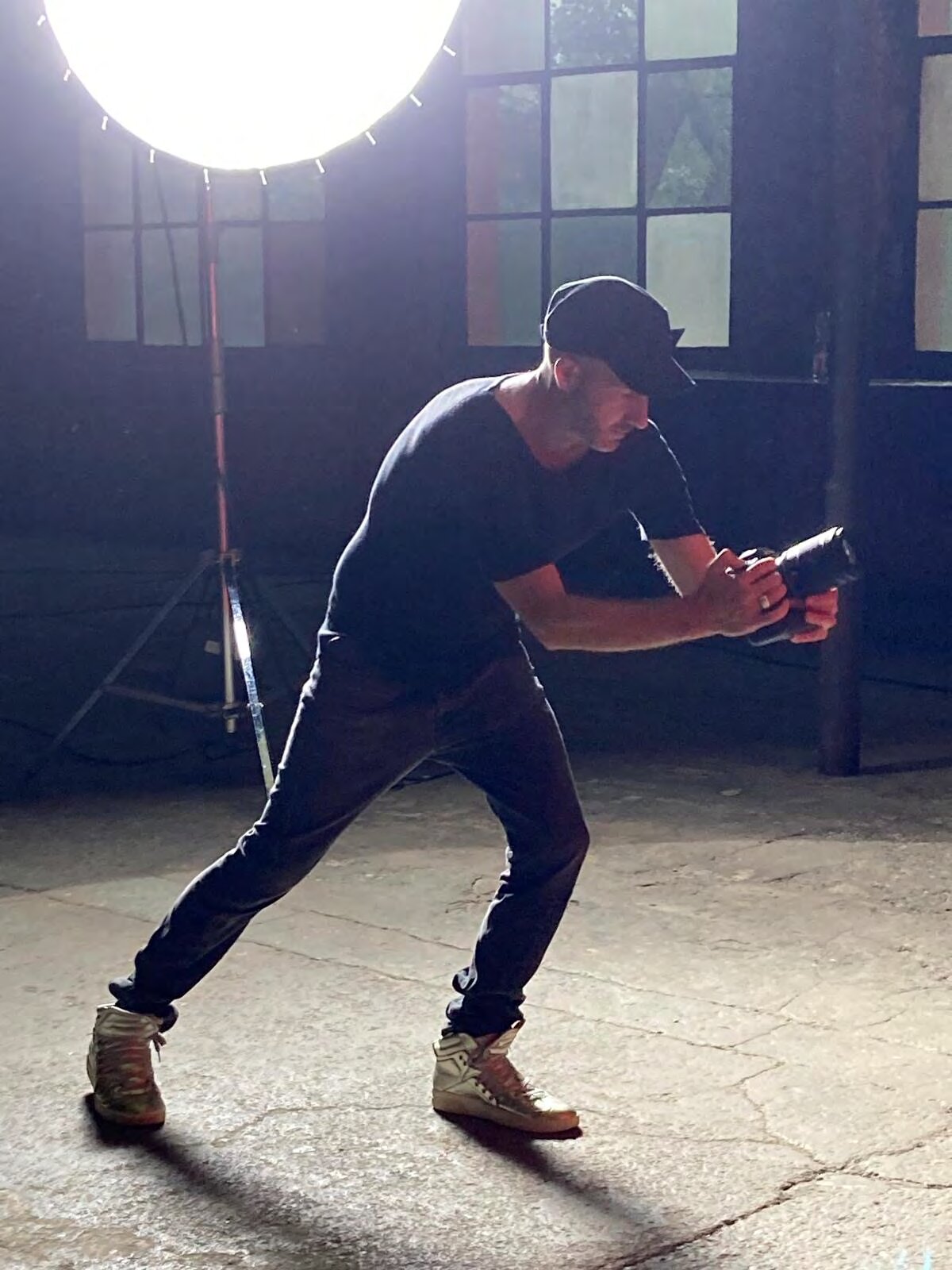
A Swiss-Irish photographer and director whose work bridges fine art, fashion, and technological exploration. With nearly 30 years of international experience, he has collaborated with houses such as Chanel and produced editorial work for Elle, Marie Claire, and L'Officiel.
His current series marks a shift inward—a poetic excavation of memory, myth, and imagined geography. Technology and transitions have always been at the forefront of his work, from analogue to digital photography, to moving image, and now artificial intelligence.
Christian grew up in West Cork, Ireland, where he began photographing at 12 and built his own darkroom. He moved to Switzerland at 17 to study photography, and has since worked across Asia, Africa, the Arctic, and the Americas.